Free AI Detector for Essays: Check Your Essay Before You Submit

Paste your essay and see how AI detectors read it. Draftout is an AI checker for essays: it runs your text through several detectors and highlights the sentences that sound like AI, so you can fix them in your own voice.

  • 4 detectors, one report
  • Instant checks, free
  • 12,000+ texts run today
0 / 5,000 words
Shall we turn your text “” into something fully human? Yes, Humanize It
Your Text:
0% AI risk
Unlock the full breakdown
There’s a 0% chance this text gets flagged as AI, even if you wrote every word yourself. Fix your weak spots now to lower the risk before you submit.
Humanize It Most academic institutions and websites will not consider your text to be original and ready to submit.
Cross-checked by
  • Sitejabber4.7
  • ProvenExpert4.7
  • Google Reviews4.7

How the essay AI detector works

Most essay checker AI tools look at grammar. This one looks for AI writing: our AI essay detector sends your essay through several detectors at once, and you get one report with an overall AI score and the exact sentences behind it.

4detectors score every essay
5,000words per scan
3upload formats: TXT, Word, PDF
1

Paste or upload your essay

Paste the text or upload a TXT, Word or PDF file. One scan covers up to 5,000 words, enough for most essays and discussion posts.

2

Several detectors score it

Originality.ai, GPTZero, Copyleaks and Scribbr each read the essay, so one detector’s mistake doesn’t decide the result.

3

See the flagged sentences

The report highlights the lines that read as AI-written. Rework those lines in your own words, then check the essay again.

What an AI essay check looks like

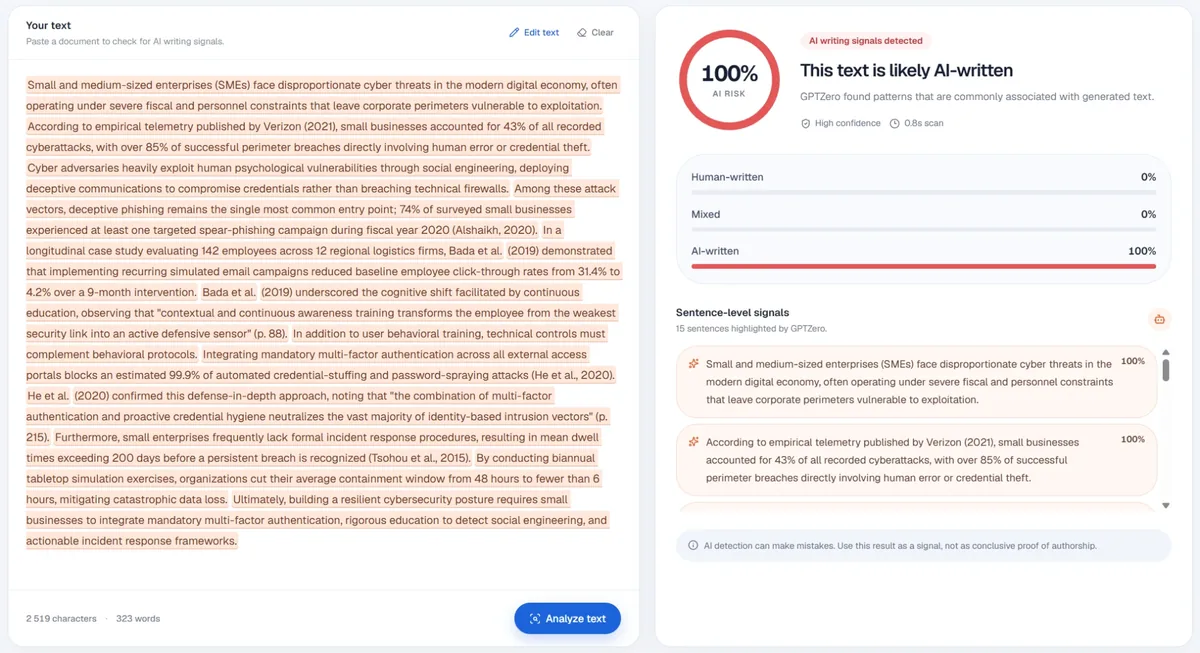
These are screenshots from the Draftout app, not mock-ups. The first is an essay a student wrote: 4%, so the report tells you there’s nothing to rework. The second is a text generated by AI: 100%, and the detectors mark it line by line. A good essay AI checker has to be able to say “this is yours”, not just raise alarms.
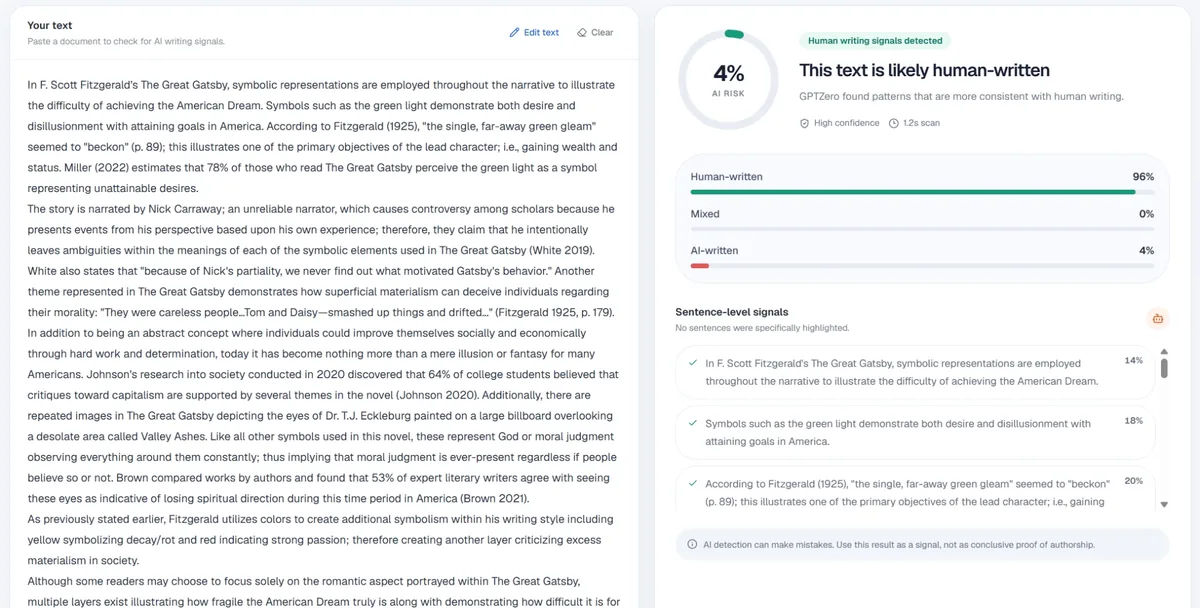
AI detector essay report from Draftout: a student essay at 4% AI risk, read as human-written
Written by a student: 4% AI risk, nothing to fix
Draftout essay AI checker report on a text generated by AI: 100% AI risk, each flagged sentence highlighted
Generated by AI: 100% AI risk, every line marked

Will an AI checker flag an essay you wrote yourself?

The fear behind most essay checks is simple: what if I wrote it myself and it still gets flagged? So we tested exactly that. In November 2026 we ran 27 texts through the Draftout app: 11 written by people, 11 written by AI and 5 that mixed both.

None of the 11 human-written texts scored above 2% AI, and none of the 11 AI-written texts scored below 98%. The mixed texts landed in between and were reported as a mix, not forced into one side.

It’s a small sample and not a guarantee for your essay. These numbers come from the full app.

0–2%AI score on 11 texts written by people
98–100%AI score on 11 texts written by AI
39–62%on 5 mixed texts, reported as “mix”

Our test, 2 November 2026: 27 texts, Draftout version 3.03, trial account, results checked by a second person. Test texts are not published.

AI detection for essays: why one checker isn’t enough

Picture checking your essay on one free site, getting 0%, and submitting it with confidence. The trouble is that your instructor doesn’t see that site. Many colleges run Turnitin’s AI writing indicator inside Canvas, and some instructors paste essays into GPTZero. Each tool has its own model, so the number you saw may not be the number they see.

We measured how far apart they can be. A 1,004-word text written by AI went through eight services’ free checkers in October 2026, and the verdicts ranged from “100% human” to 100% AI. A chapter of Pride and Prejudice, written two centuries before chatbots, came back 37% AI on one checker and 3% on another.

So Draftout reads every essay with several detectors. If they agree, you know where you stand. If they split, the highlighted sentences show what to look at before you touch anything. More on what AI detector colleges use and how the AI score shows up in Canvas.

Method: one AI-written and one human-written text, free tiers only, one run per checker, 6–12 October 2026.

Why is my essay flagged as AI?

Wondering “does my essay sound like AI?” Detectors don’t know who wrote your essay. They react to patterns, and some of them show up in honest student writing too.

01

Even sentence rhythm

Every sentence about the same length and shape. Mix short and long sentences the way you’d say them out loud.

02

Generic transitions

“Furthermore”, “In today’s society”, “In conclusion” in every paragraph. Link ideas with what actually connects them.

03

A boilerplate thesis statement

A thesis that could open any essay on the topic. Make it a claim only you would argue, with your angle and your example.

04

No personal detail

Claims without your own examples, sources or reading of the text. Add the detail you noticed and a detector can’t predict.

05

Over-polishing

Running a finished essay through grammar or rewording tools can smooth out your voice. Keep your own phrasing where it’s correct.

06

Formal or non-native writing

Careful, formulaic English is flagged more often. That’s a known limit of detectors, so keep your drafts and notes as evidence.

From flagged to yours: one paragraph, start to finish

An example we wrote for this page: the opening of an argumentative essay on teens and social media, the way detectors tend to flag it, and a rewrite in the writer’s own voice.

The flagged paragraph

“In today’s digital age, social media plays a crucial role in the lives of teenagers. Furthermore, it has both positive and negative effects on their mental health. It is important to consider these effects in order to understand their impact on society.”

Why detectors react

Three sentences of almost the same length. Two stock openers, “In today’s digital age” and “Furthermore”. A thesis that could start any essay on the topic, with no claim of its own and no detail a reader couldn’t predict.

The rewrite in your voice

“Most teens I know have deleted Instagram at least once, and most of them reinstalled it within a week. That pattern says more than any screen-time chart: the hard part isn’t the app, it’s the habit. This essay argues that schools should teach the habit, not ban the app.”

What changed: the sentences vary in length, the thesis takes a side, and the detail comes from the writer’s own world. You don’t need a tool for that part; you need to know which lines to rework, which is what the report shows you.

An AI checker for every kind of essay

An AI detector for students, built for the essays they actually submit, from a college application to a weekly discussion post.

College and application essays

Use it as a college essay AI checker for your personal statement or supplemental essays before they go to admissions.

  • Make sure your own story doesn’t read as AI
  • Spot generic lines that sound like everyone else’s
  • Keep your voice while you polish

Argumentative and persuasive essays

Check the essays you submit through Canvas or Turnitin for class.

  • See which paragraphs trigger the detectors
  • Rework flagged lines, keep your argument
  • Check again before the deadline

Discussion posts and short responses

Short texts are hard for detectors, so check them before you post.

  • Paste a post of 80 words or more
  • Read the flagged sentences, not only the score
  • Add your own example where it reads generic

Checking a research paper or a thesis? Use the AI text detector: same check, up to 5,000 words per scan, chapter by chapter for longer work.

Check your essay for AI before you submit

Check before you submit: a four-step routine that fits between your last draft and the upload button.

1

Finish your draft

Write it in your own words. If you used AI for ideas or an outline, follow your course’s rules on it.

2

Check it for AI

Run the essay through Draftout and read which sentences were flagged and by how many detectors.

3

Fix the flagged lines

Rework them yourself, or use the AI Humanizer on passages you drafted with AI. Then check again.

4

Check for plagiarism

AI detection doesn’t look for copied text. Run the plagiarism checker on the same essay, then submit.

What nextA low AI score doesn’t mean your essay is readyThe AI check tells you how your essay reads to detectors, not whether the argument holds up or every source is cited. After you humanize your essay, Check my grade reviews it against 12 academic criteria and gives you an estimated grade and a revision plan, so you see what to fix before you submit.
Check for AIHumanizeCheck my gradeRevise

An AI score is a signal, not a verdict

Draftout is here to help you hand in an essay that is genuinely yours. Every detector, ours included, makes mistakes in both directions. What counts as allowed AI use is set by your course and your school, so read their policy, and keep your drafts and version history in case you’re asked how the essay came together.

More tools for your essay

AI essay checker FAQ

Paste your essay into the checker above or upload a TXT, Word or PDF file, then press Scan for AI Content. Draftout scores it with several AI detectors and highlights the sentences that read as AI-written. Essays need at least 80 words; one scan covers up to 5,000.
A detector can’t tell who wrote your essay; it can only tell you which parts read like AI. Look at the flagged sentences, not only the score. The usual reasons are an even sentence rhythm, generic transitions, a thesis that could open any essay and no personal detail. Rework those lines in your own words and check again.
Because detectors judge patterns, not authorship, and careful student writing can share those patterns: formal phrasing, stock transitions, a by-the-book structure. Non-native writers are flagged more often for the same reason. Even a novel from 1813 came back 37% AI on one checker in our October test. Compare the detectors in your report, rework the flagged lines if you want to, and keep your drafts and notes as evidence of your process.
Many can see an AI score: colleges often run Turnitin’s AI writing indicator in Canvas or another learning platform, and some teachers use GPTZero. Teachers also notice a voice that doesn’t match your earlier work. More in how teachers detect AI.
Turnitin is the most common, usually through the school’s learning platform. Students can’t run Turnitin’s AI check themselves, so the closest thing is checking your essay with several detectors before you submit. Full answer in what AI detector colleges use.
Yes, the AI check is free: paste your essay and get a score with the flagged sentences highlighted. Rewriting flagged passages with the AI Humanizer is part of the paid plan, with a 2-day trial for $2, then $39.99/month.
Yes. Draftout works as an AI detector for college essays: paste your personal statement or supplemental essay and see which lines read as AI. Admissions essays are short and personal, so read the flagged sentences closely and keep your own story and voice.
No. A score estimates how likely a text is to be AI-written; it doesn’t prove who wrote it. That’s why Draftout shows several detectors and the sentences behind the score. Your school’s policy decides what counts as AI use. Turnitin’s own score has limits too, see how accurate Turnitin’s AI detector is.
At least 80 words, and up to 5,000 per scan. Very short texts give detectors too little to go on, so a 50-word answer can swing either way. For longer work, check it section by section so each report stays easy to read.

Written and tested by the Draftout team. Updated November 5, 2026.

Check your essay before you submit

Paste your essay, see which sentences read as AI, and fix them in your own voice.

The AI check is free. The Humanizer comes with a 2-day trial for $2, then $39.99/month.