To detect AI writing, combine three checks. Read the text for the patterns language models leave behind, run it through more than one AI detector, and compare it with the writer’s earlier work and drafts. No single signal proves anything. A high score or a stiff paragraph is a reason to look closer, not a verdict.
That last part matters more than most guides admit. Picture a typical case. Maya, a sophomore, wrote her history paper over two weekends in Google Docs. Her instructor ran it through one detector, got a 64% AI score and sent her an email that ruined her Sunday. Her version history showed 11 hours of edits. The flag was wrong.
Maya, Daniel and Jordan in this guide are composite examples, not real people or cases.
If you’re a student, you’ve probably worried about a moment like that. If you teach, you’ve probably wondered whether a paper sounded “too smooth.” Both concerns are fair.
This guide shows you how to detect AI-written text the way careful readers do it. You’ll learn the signs to look for, how AI detectors work and where they fail. Then you’ll see how to check your own essay before you submit.
- No method can detect AI writing with certainty. OpenAI retired its own classifier in 2023 after it caught only 26% of AI-written text.
- The most reliable signs are patterns, not single words: uniform sentence rhythm, generic claims without specifics, vague or invented citations, and a voice that doesn’t match the writer’s other work.
- AI detectors measure statistical predictability. Plain, formulaic or non-native English writing can score as “AI” even when a person wrote every word.
- Use at least two detectors and compare results. Turnitin itself hides scores below 20% because they’re less reliable.
- The strongest evidence of authorship is process: drafts, notes, version history and the ability to explain your own argument.
Can You Reliably Detect AI Writing?
You can’t reliably detect AI writing from the text alone, but you can build a strong, fair judgment from several signals together. Every detection method works on probability. None of them can see how a text was actually produced.
The clearest proof comes from the companies that build these models. In July 2023, OpenAI shut down its own AI text classifier because of its low accuracy. In OpenAI’s tests, it correctly flagged only 26% of AI-written text and wrongly labeled 9% of human text as AI.
Independent research points the same way. A 2023 study in the International Journal for Educational Integrity by Weber-Wulff and colleagues tested 14 detection tools. None reached 80% accuracy, and the tools did worse when AI text had been lightly edited by a person.
Tools have improved since then. Still, the core problem hasn’t gone away: a detector sees words on a page, not the writing process behind them. So treat any single result as one data point.
Want to see how different detectors score the same paragraph? Draftout’s AI Detector runs your text through several detectors, not just ours, so you can compare before you draw conclusions.
What Are the Signs of AI-Written Text?
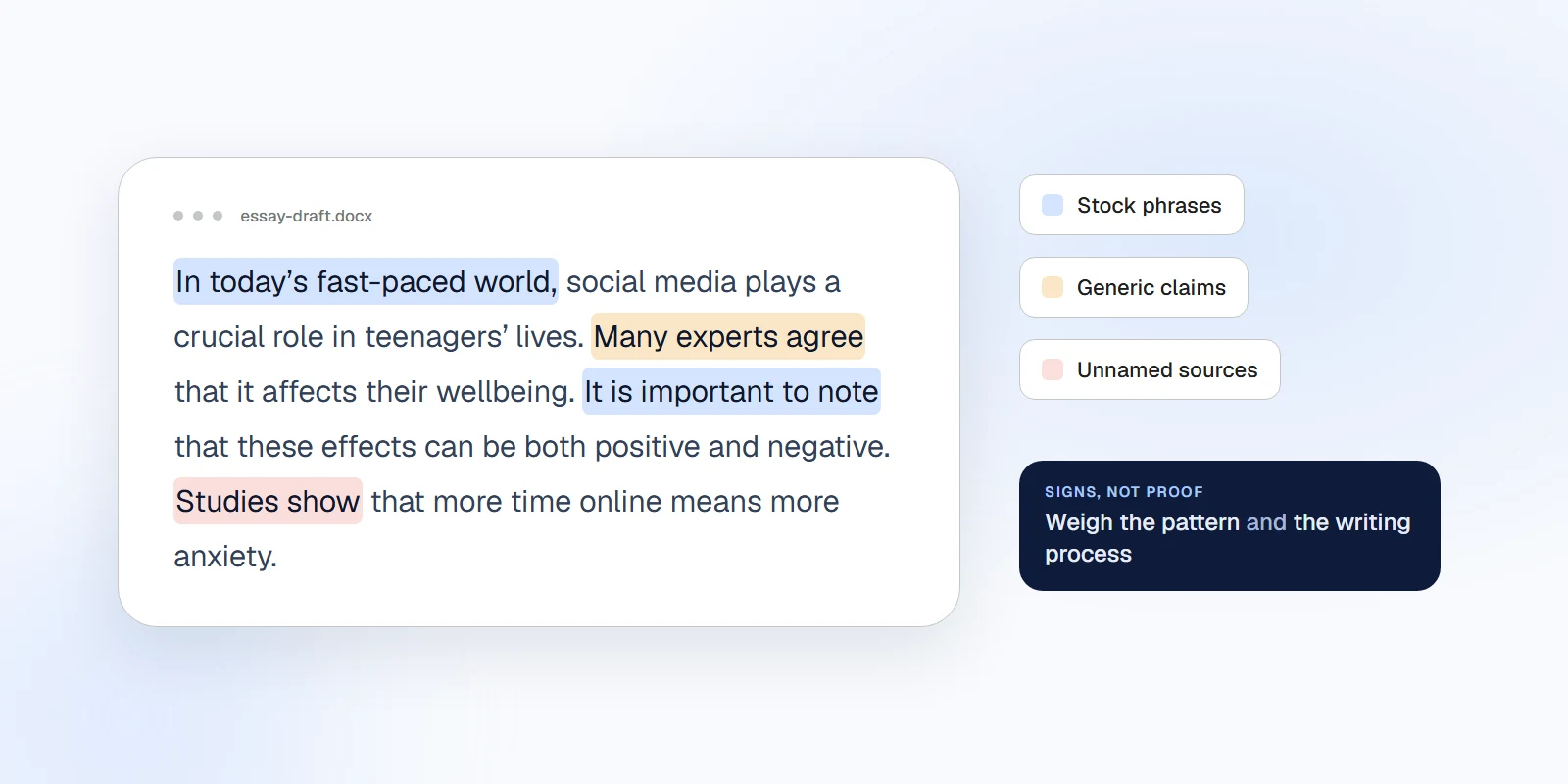
The signs of AI-written text are patterns that show up across a whole document. One stock phrase means little. Five of these signs together in a short essay are worth a closer look.
| Sign | What it looks like | How strong a signal |
|---|---|---|
| Uniform rhythm | Sentences of similar length and shape, paragraph after paragraph | Medium |
| Generic claims | Big statements with no names, numbers, dates or examples | Medium |
| Stock phrases | “plays a crucial role,” “in today’s fast-paced world,” “it’s important to note” | Weak alone |
| Tidy structure | Every paragraph opens with a topic sentence and closes with a summary | Weak alone |
| Vague or invented sources | Citations that don’t exist or don’t say what the text claims | Strong |
| Voice mismatch | Style, vocabulary or skill level unlike the writer’s other work | Strong |
| Confident errors | Wrong facts stated smoothly, with no hedging | Medium |
| Inflated claims | “one of the most profound transformations in human history” for an ordinary topic | Medium |
| Triplets and “not just X, but Y” | Lists of exactly three; sentences that define a thing by what it isn’t | Weak alone |
Uniform sentence rhythm
AI text tends to have low “burstiness.” Human writers mix short sentences with long ones. They interrupt themselves. Language models, left on default settings, often produce sentences of steady medium length.
Read a paragraph out loud. If every sentence lands with the same beat, note it.
Generic statements without specifics
Models are good at sounding right in general. They’re weaker at the specific detail a person adds from experience or close reading. Watch for paragraphs that say “many experts agree” or “studies show” without naming a single expert or study.
A student who read the assigned book quotes page 112. A generic draft says “the author explores themes of identity.”
Stock phrases and hedges
Some phrases appear far more often in AI output than in student writing. The volunteer editors at Wikipedia keep a long, useful list in their guide to signs of AI writing. Examples include “delve into,” “a testament to,” “rich tapestry” and summaries that start with “Overall.”
The same goes for single words. Editors who read a lot of AI output often say that fancy picks like “profound,” “pivotal” or “moving beyond” appear more than they would in a student essay.
Be careful here. Plenty of people write this way too, especially after years of formal essay training. Phrases are the weakest sign on the list. Detectors work in a similar way: no single word decides the score. A pile of statistically predictable choices does.
Inflated, dramatic claims
Language models like big statements. A paragraph about a school technology policy calls it “one of the most profound shifts in education.” A software tool becomes “a central pillar of modern life.” Ask what the claim means, and there’s often nothing specific behind it.
Vague time frames work the same way. “In the past decade” sounds precise but isn’t. A writer who knows the topic says “since 2016” and moves on.
Lists of three and “not just… but” framing
Models love triplets: “collaborators, co-creators and decision makers.” They also like to define a point by what it isn’t: “not just technological, but cultural and philosophical.” Stacked “-ing” clauses are another habit: “reshaping industries, transforming education, forcing us to rethink everything.”
Each of these is normal English. The sign is repetition. If three paragraphs in a row use the same move, that’s a pattern, not a style choice.
Invented or mismatched citations
This is one of the strongest signs. Language models can produce references that look real but don’t exist, or real sources that don’t support the claim. Check two or three citations: does the article exist, and does it say what the paper says it does?
Building your own citations as you research avoids this problem completely. Our guide to a better citation workflow walks through it.
A voice that doesn’t match the writer
Teachers often spot AI writing because a paper doesn’t sound like the student. Vocabulary jumps, sentence structure changes, or the analysis is far more polished than earlier work. This is a strong signal, but it needs a baseline: you can only compare against writing you know is theirs.
How Do AI Detectors Detect AI Writing?
AI detectors detect AI writing by measuring how statistically predictable a text is, then comparing it with patterns learned from known human and AI samples. They don’t search a database of ChatGPT answers. They estimate probability.
Most tools rely on some mix of three ideas:
- Perplexity. How surprised a language model is by each next word. AI text is usually low-perplexity, because models pick likely words.
- Burstiness. How much perplexity and sentence length vary across the text. Human writing tends to vary more.
- Trained classifiers. A model trained on large sets of labeled human and AI writing learns to sort new text into one group or the other.
| Sentence | Student essay | AI draft |
|---|---|---|
| 1 | 6 | 16 |
| 2 | 22 | 18 |
| 3 | 14 | 17 |
| 4 | 3 | 15 |
| 5 | 28 | 19 |
| 6 | 11 | 17 |
| 7 | 17 | 16 |
| 8 | 8 | 18 |
The output is an AI-likelihood score, often shown as a percentage. A 70% score doesn’t mean 70% of the essay was written by AI. Depending on the tool, it may mean the detector is 70% confident, or that 70% of sentences matched AI patterns. Read each tool’s documentation before you trust the number.
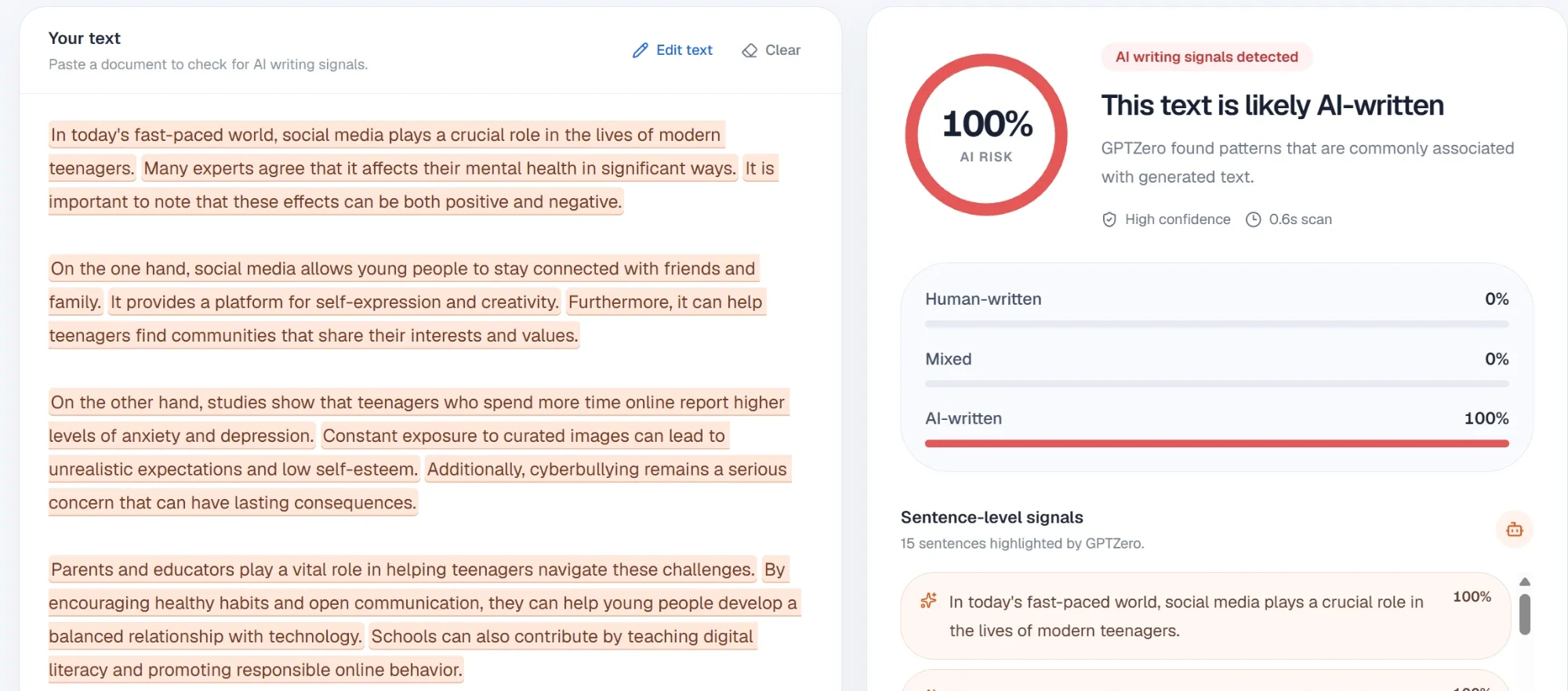
Turnitin is open about this. Its AI writing report shows an asterisk instead of a score when the detected share is between 1% and 19%, because its testing found a higher incidence of false positives in that range. Turnitin also reports a document-level false positive rate below 1% for documents with 20% or more AI writing, and a sentence-level rate of around 4%.
Why one detector isn’t enough
Detectors are trained on different data and tuned to different thresholds. The same paragraph can get a low score in one tool and a very high score in another. That gap is the best argument for checking with more than one. In our test of ten AI detectors on the same texts, one AI-written essay scored anywhere from 4% to 100% AI.
This is exactly why Draftout scores text with several detectors instead of one in-house model. When most tools agree, you learn something. When they disagree, you’ve learned that the score alone can’t settle the question.
How to Detect AI Writing: A Step-by-Step Process
The fairest way to detect AI writing is to move from low-stakes checks to high-stakes ones, and to stop the moment you have a reasonable explanation. Here’s the order careful instructors and editors use.
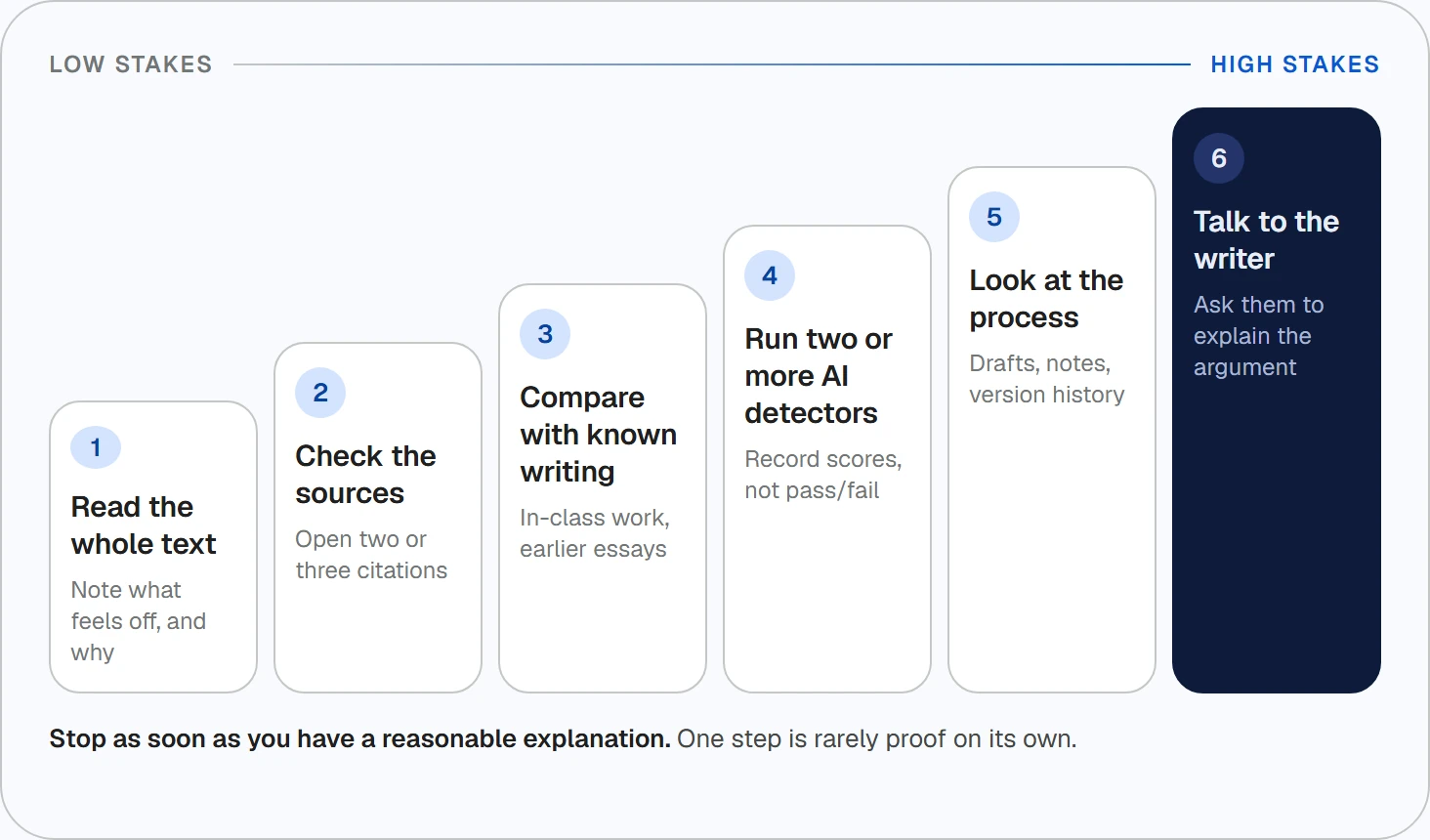
- Read the whole text first. Note specific passages that feel off, and why. “Generic” is too vague. “Paragraph 3 makes four claims and supports none” is useful.
- Check the sources. Open two or three citations. Fake or mismatched references are hard evidence. Real, well-used sources point the other way.
- Compare with known writing. Look at in-class work, earlier essays or emails. A sudden change in voice matters more than any phrase.
- Run at least two AI detectors. Paste the same text into each. Record the scores, not just a pass or fail.
- Look at the process. Ask for drafts, outlines, notes or document version history. Google Docs and Word both keep edit history.
- Talk to the writer. Ask them to explain their thesis, why they chose a source, or what they’d change. People who wrote a paper can usually discuss it.
Here’s how a case like this might play out. Daniel teaches first-year composition at a state college. A student essay comes back at 82% AI in his school’s detector.
Instead of filing a report, he checks the four sources (all real and correctly quoted), then asks the student to walk him through the argument in office hours. She explains it clearly and shows him her outline from week two. Daniel closes the case in 20 minutes. His note in the file: “Detector score alone is not evidence.”
Step 6 is the most humane one, and often the most accurate.
Why AI Detectors Get It Wrong: False Positives
AI detectors produce false positives when human writing looks statistically predictable. Clear, simple, rule-following prose is exactly what detectors are tuned to flag, which means some writers get flagged more than others.
The best-known study on this comes from Stanford. Liang and colleagues, writing in the journal Patterns in 2023, ran seven detectors on 91 TOEFL essays written by non-native English speakers. On average, the detectors labeled 61% of these human-written essays as AI-generated, and at least one detector flagged 98% of them. Essays by US eighth graders were classified with near-perfect accuracy. When ChatGPT was asked to polish the wording of the TOEFL essays, the average false positive rate dropped to about 12%, which suggests that detectors penalize simpler, more predictable vocabulary.
| Measure | Share flagged as AI |
|---|---|
| Flagged by at least one detector | 97.8% |
| Average across the 7 detectors | 61.3% |
| Flagged by all 7 detectors | 19.8% |
| Average after ChatGPT polished the wording | 11.6% |
Turnitin published its own evaluation. It found no statistically significant bias against English language learners in texts of 300 words or more, and a larger gap in shorter ones. That’s the company’s own research, not an independent study, so treat it as one data point. Results vary by tool, but the risk is real enough to take seriously.
Writing that tends to trigger false positives:
- Non-native English with simpler vocabulary and sentence structure
- Formulaic genres such as lab reports, abstracts and five-paragraph essays
- Heavily edited text where grammar tools smoothed out every rough edge
- Short texts under 250 to 300 words, where detectors have too little to measure
- Common knowledge like definitions and textbook explanations
None of this means detectors are useless. It means a score is a starting point for a conversation, never the end of one.
How to Check Your Own Essay Before You Submit
The simplest way to check your own essay is to run it through more than one AI detector, review any flagged sentences, and keep evidence of your writing process. You’re not trying to game a tool. You’re making sure your own work reads like you.
Take Jordan, another composite example: a junior who wrote a 2,000-word policy paper with help from a grammar tool. Two days before the deadline, Jordan ran the draft through two detectors. One scored it 12%, the other 47%, with the flagged sentences all in the literature review. Those were the paragraphs Jordan had rewritten most with suggestions.
Jordan revised them in plain, personal wording, added two specific examples from the readings, and kept the Google Docs history. The paper went in with confidence, and the history was there if anyone asked.
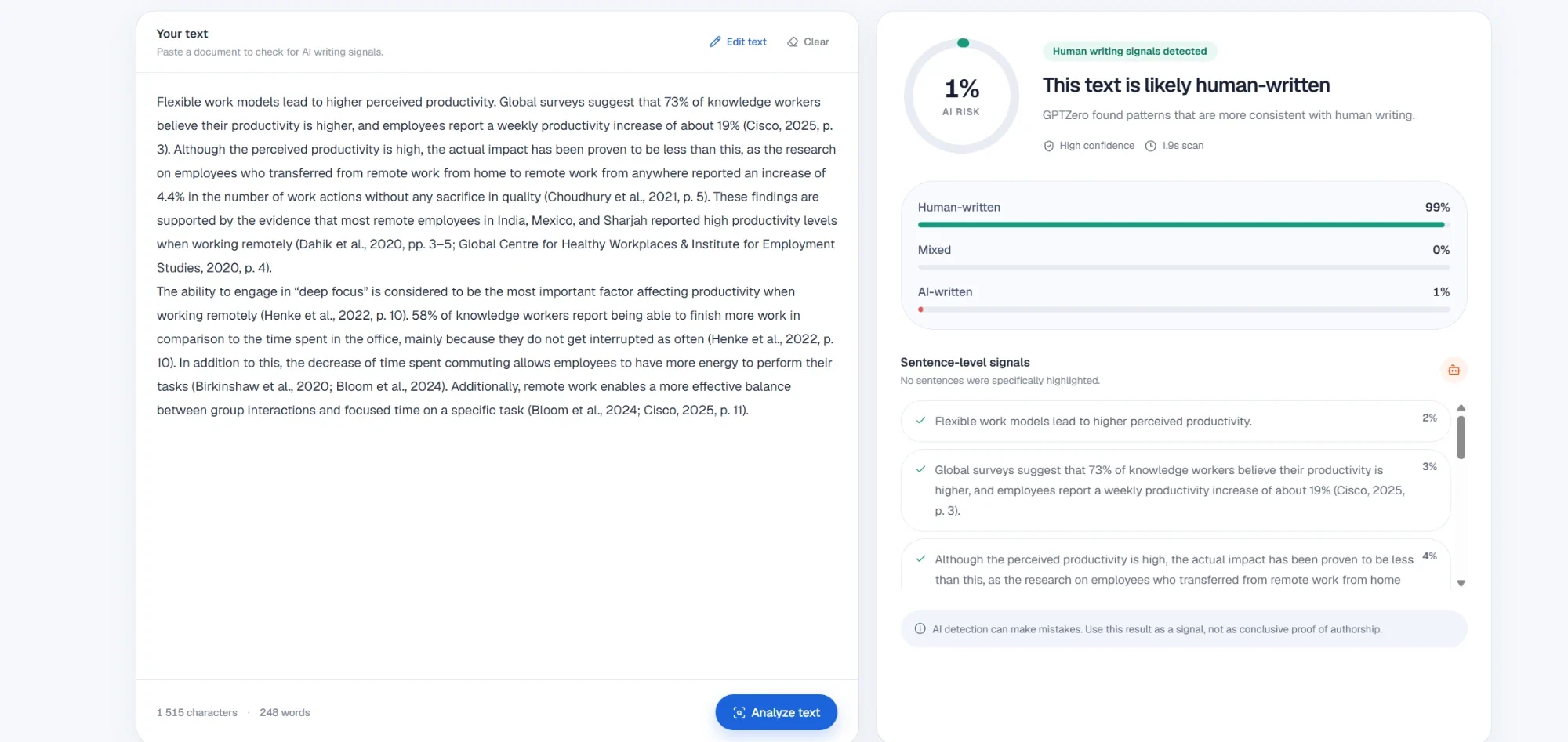
Here’s a short pre-submission checklist:
- Run two or more detectors and compare the scores. Look at which sentences get flagged, not just the total.
- Revise flagged passages in your own voice. Add a specific example, a number, or your actual opinion. Specifics are the most natural fix. Our guide on how to humanize AI writing walks through it step by step.
- Check every citation against the original source.
- Run a plagiarism check to catch quotes you forgot to cite. Draftout’s plagiarism checker shows where your text matches existing sources.
- Paraphrase carefully. If you reworded a source, make sure it’s cited. A paraphrasing tool can help you rephrase a clunky sentence, but the ideas and the citation still need to be yours.
- Save your process. Keep outlines, notes and version history until grades are final.
- Read your school’s AI policy. Many courses allow AI for brainstorming but not drafting. Know the line before you cross it by accident. If you submit through Canvas, check whether your Canvas assignment is checked for AI.
Ready to check your draft before you submit? Run it through Draftout’s AI Detector and see how several detectors score it side by side. A 2-day trial costs $2.
Frequently Asked Questions About Detecting AI Writing
Is there a 100% accurate AI detector?
No, there is no 100% accurate AI detector. Every tool makes errors in both directions: it misses some AI text and flags some human text. Accuracy also drops for short passages and lightly edited AI output. That’s why comparing several detectors gives you a more honest picture than trusting one.
How do teachers detect AI writing?
Teachers detect AI writing with a mix of detection software and their own judgment. Many schools use Turnitin’s AI report. Teachers also compare a paper with a student’s in-class writing, check whether citations are real, and ask students to explain their work. A detector score usually starts the process rather than ending it.
What is the 30% rule for AI?
The “30% rule” isn’t an official standard. Some instructors use it as an informal guideline. In one version, AI may assist with no more than about 30% of an assignment. In another, AI scores above 30% get a closer look. Policies differ by course, so check your syllabus or ask your instructor directly.
How do I prove I didn’t use AI?
You prove you didn’t use AI by showing your writing process. Share your Google Docs or Word version history, outlines, notes, and the sources you read. Offer to talk through your argument. Process evidence is far stronger than any detector score, in either direction.
Can Grammarly or other editing tools make my writing look AI-generated?
Yes, heavy editing can raise an AI score. Grammar and rewriting tools push text toward smoother, more predictable wording, which is what detectors look for. Accepting a few corrections is usually fine. Accepting every rewrite suggestion across a whole essay can change how it scores. Grammarly’s own detector, for example, typically ignores grammar fixes but flags text its generative tools rewrote; our Grammarly AI detector review has the details and our test results. QuillBot’s paraphraser is another common case: our QuillBot AI detector review covers what its own detector and Turnitin say about it.
What AI score is too high?
There’s no universal cutoff. Turnitin doesn’t show scores below 20% at all, because they’re less reliable. Many instructors only look closer at much higher scores, and only alongside other evidence. If your score is high, check which sentences are flagged and whether other detectors agree.
Conclusion: Detect AI Writing With Evidence, Not a Single Score
The best way to detect AI writing isn’t to hunt for a magic phrase. It’s to weigh the evidence fairly. Here’s what to remember:
- No tool can detect AI writing with certainty, including the ones built by AI companies.
- Strong signs are invented citations and a voice that doesn’t match the writer. Stock phrases are weak signs.
- Detectors measure predictability, so clear, simple or non-native writing can be flagged by mistake.
- Use two or more detectors, and treat disagreement between them as useful information.
- Process evidence, like drafts and version history, beats any score.
If you’re a student, check your essay before you submit, revise flagged passages in your own voice, and keep your drafts. If you teach, use scores to start a conversation, not to end one.
Check your text with Draftout’s AI Detector → Draftout is an AI writing toolkit for students, and its detector scores your writing with several detectors so you can submit with confidence. See pricing for the $2 2-day trial.

Table of contents
- Can You Reliably Detect AI Writing?
- What Are the Signs of AI-Written Text?
- How Do AI Detectors Detect AI Writing?
- How to Detect AI Writing: A Step-by-Step Process
- Why AI Detectors Get It Wrong: False Positives
- How to Check Your Own Essay Before You Submit
- Frequently Asked Questions About Detecting AI Writing
- Conclusion: Detect AI Writing With Evidence, Not a Single Score
