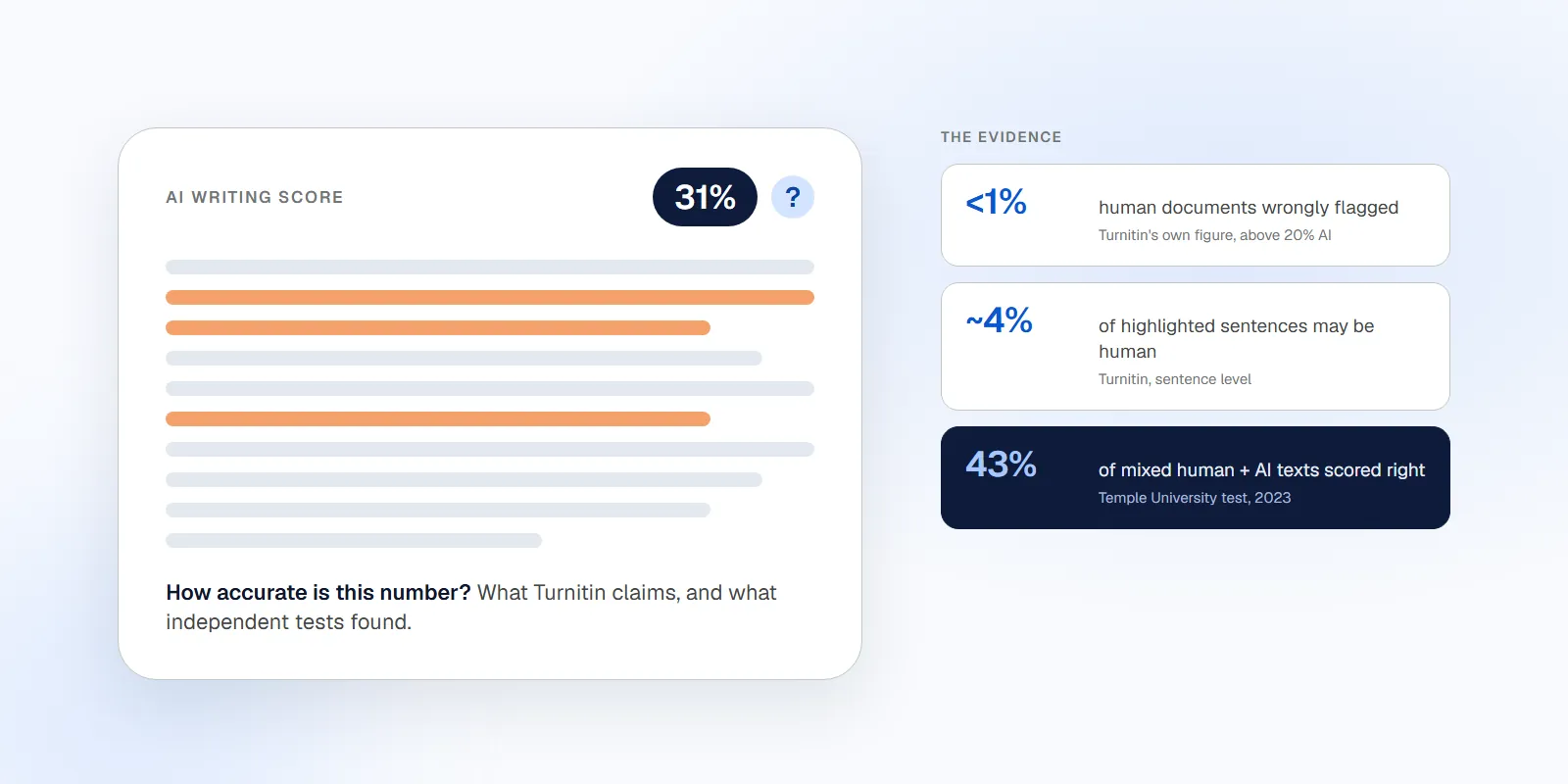
Partly. Turnitin says its AI detector wrongly flags fewer than 1 in 100 fully human-written documents (those it scores above 20% AI)[1], and it’s tuned to miss some AI text rather than accuse a human writer. Independent tests are older and smaller, and they’re less comforting: a Temple University study found Turnitin right on 93% of human texts but only 43% of mixed human and AI texts[6].
If you’re here, you probably have a Turnitin score in front of you, or you’re about to submit and don’t know what your professor will see. Say you’ve just opened your report and it reads 31%. The number feels like a verdict, and you can’t tell whether it’s reliable.
This article explains what Turnitin claims, what outside tests found, what the numbers actually mean, and what to do if a score looks wrong. Every figure has a numbered source listed at the end, and we say where the evidence is old or thin.
Disclosure: Draftout makes an AI detector, so we have a stake in this topic. We don’t run Turnitin and have no access to its scores; every figure here comes from the source it cites.
You can’t see your school’s Turnitin result, but you can see how a draft reads to other detectors. Before you submit, run it through an AI text detector that scores it with several detectors at once; the check is free.
- Turnitin says its document-level false positive rate is under 1% for documents above 20% AI, and its sentence-level rate is about 4%[1][4].
- Temple University tested 120 texts: Turnitin got 93% of human texts right, 77% of pure AI texts, 63% of paraphrased AI texts and 43% of hybrid texts[6].
- The tool is tuned to under-report AI. Turnitin’s FAQ says a document scored at 50% AI could contain as much as 65%[1].
- Turnitin itself says the score “should not be used as the sole basis for adverse actions” against a student[3].
- Vanderbilt and Waterloo turned the feature off[5][10]. You can’t see your school’s score, so check your draft with several detectors before you submit.
How Accurate Is Turnitin’s AI Detector According to Turnitin?
Turnitin’s AI detector is accurate by Turnitin’s own measure when it comes to protecting human writers. The company says it keeps the false positive rate under 1% for documents with more than 20% AI writing[1], meaning about one fully human-written document in 100 might be flagged.
Turnitin says it checks that rate before every model release against 700,000 papers written before ChatGPT existed. In 2023 its Chief Product Officer cited a similar 800,000-paper test[2].
The trade-off is built in. Turnitin’s FAQ admits the detector will sometimes miss AI text: if it finds that 50% of a document is likely AI, “it could contain as much as 65% AI writing.” In other words, the model leans toward giving the writer the benefit of the doubt.
Two more facts from Turnitin’s own pages matter for how you read a score:
- It isn’t a verdict. The AI Writing Report guide[3] says the model “may not always be accurate” and shouldn’t be the sole basis for adverse action against a student.
- There’s no target score. Turnitin’s own blog[4] says there is no “right” score, and instructors should use results “to initiate a conversation, not to draw a conclusion.”
What Does a “1% False Positive Rate” Mean for You?
A 1% document false positive rate means roughly 1 in every 100 fully human-written papers could be wrongly flagged. That sounds small, but it adds up across a whole campus.
Vanderbilt did the math in 2023. It had submitted about 75,000 papers to Turnitin in 2022[5]. At a 1% rate, around 750 student papers could have been wrongly labeled as partly AI-written. Vanderbilt turned the detector off.
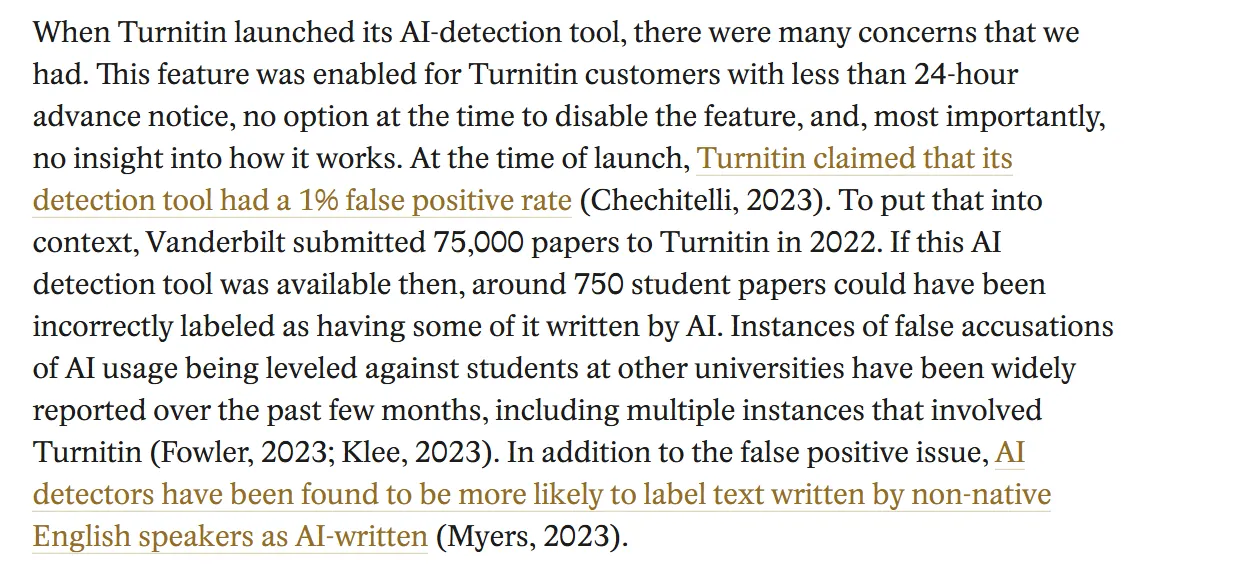
Two details keep this number from being a simple guarantee:
- It’s conditional. The under-1% figure applies to documents Turnitin scores above 20% AI. Turnitin says scores under 20% have a higher rate of false positives, which is why it shows them as an asterisk (
*%) with no highlights. - It’s a vendor figure. It comes from Turnitin’s own testing. The independent tests below are smaller and use older versions of the model.
What About the Sentence-Level Rate?
Turnitin’s sentence-level false positive rate is about 4%. That means a highlighted sentence has a roughly 4% chance of being human-written.
Turnitin’s data shows where those mistakes happen. 54% of false-positive sentences sit right next to real AI writing[2], 26% are two sentences away and 10% are three away. Only the last 10% are nowhere near AI text.
So a human sentence is most likely to be flagged at the seam where AI and human writing meet. If you used an AI tool for an outline or a few sentences, the sentences around that text are the ones most exposed to a wrong highlight.
What Do Independent Tests Say About Turnitin’s Accuracy?
Independent tests find Turnitin good at recognizing fully human writing and weaker on mixed or paraphrased text. The best-documented one is Temple University’s.
Temple’s Student Success Center and Center for the Advancement of Teaching ran 120 texts through Turnitin[6], 30 in each category:
| Text type | Rated correctly | What happened |
|---|---|---|
| Fully human | 28 of 30 (93%) | One scored 11% AI, one couldn’t be rated |
| Fully AI (ChatGPT) | 23 of 30 (77%) | Five scored 52% to 97% AI, two couldn’t be rated |
| AI text run through a paraphraser | 19 of 30 (63%) | Eight scored 43% to 95% AI, three couldn’t be rated |
| Hybrid (human and AI mixed) | 13 of 30 (43%) | Six were rated fully AI, seven fully human |
Temple’s authors also checked the highlighted sentences in hybrid texts and found no relationship between what Turnitin flagged and what the AI had actually written. Their conclusion was balanced: a flag could be a useful signal where AI use is strictly banned, but “a 14% error rate in detecting AI generated text is not insignificant,” and instructors shouldn’t rely on the report to tell which parts a student wrote.
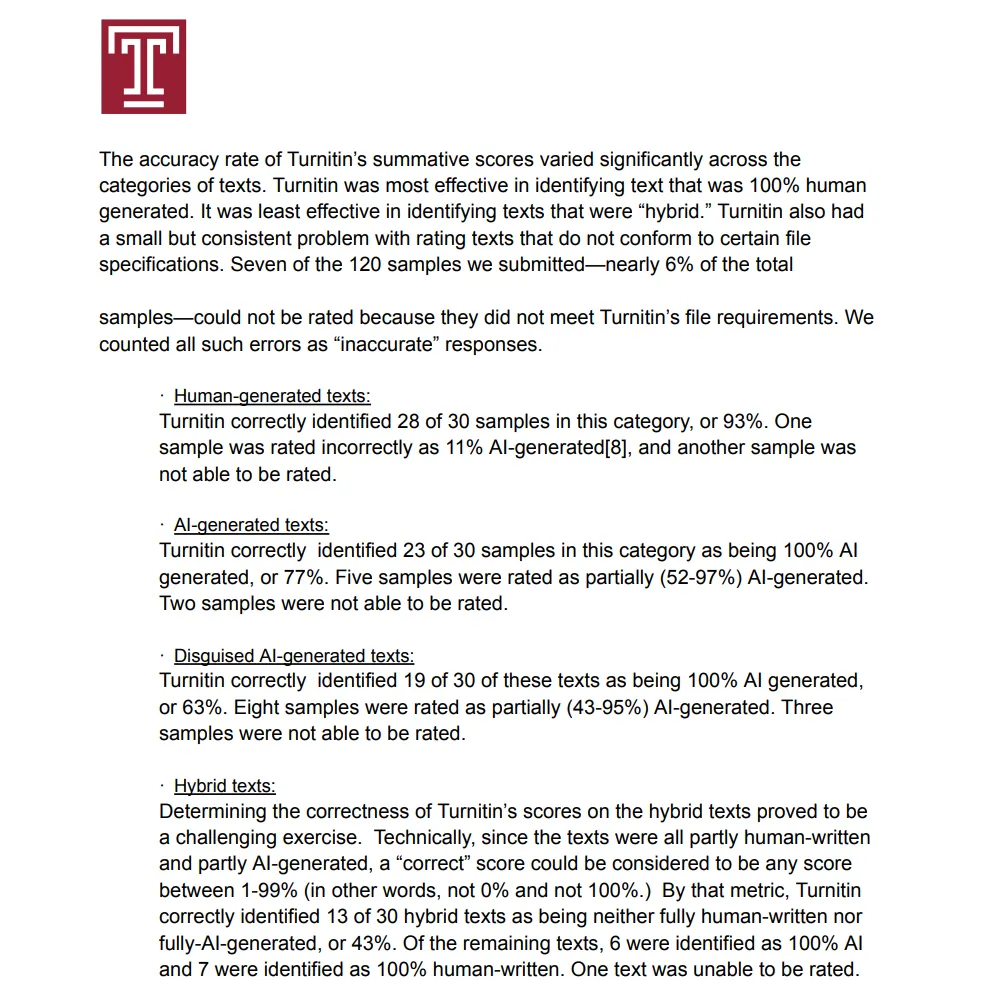
Read this table with care. The report was published in summer 2023 (Temple’s file is dated August 2023), the human texts predate November 2022, and Turnitin’s model has been updated several times since. It shows how an early version behaved, not how the current one does.
Temple also ran the same texts through four other detectors (ZeroGPT, Copyleaks, Crossplag and Content at Scale). In its addendum[7], none of them labeled every human text correctly, and the authors judged them less reliable than Turnitin. So in that test, Turnitin’s weak spot was shared by the whole category, not unique to it. Our own November 2026 test points the same way: 10 public detectors scored the same AI-written essay anywhere from 4% to 100% AI, as our best AI detector comparison shows.
Other evidence points the same way:
- BestColleges tested three texts[8] in 2023: a human essay scored 0% and a ChatGPT essay scored 100%. That’s a useful demo, but three texts can’t measure a false positive rate.
- The University of Kansas teaching center notes[9] that Turnitin scores appear to carry a margin of error of around 15 points, and that the tool works best on long-form prose.
- Waterloo says its own testing was inconclusive, and that Turnitin flagged human-written text as 100% AI in more than one case[10].
Can Turnitin Flag Human Writing as AI?
Yes, it can. Turnitin’s own documentation says the model may misidentify human-written text[3], and its sentence-level data shows how[4].
The risk is higher in a few situations:
- Mixed drafts. A paper where you used AI for brainstorming or grammar can have human sentences highlighted next to AI-assisted ones.
- Short or formulaic passages. Turnitin needs at least 300 words of prose and works best on long essays[3]. Its own tests found more false positives at the start and end of documents[2], where introductions and conclusions tend to be generic.
- Writing by non-native English speakers. A Stanford-led study ran 91 TOEFL essays by non-native English writers through seven detectors. On average they flagged 61% of the essays as AI-generated[11], and all seven agreed on 18 of them, while essays by US eighth-graders were classified almost perfectly. Turnitin was not one of the seven detectors tested, so that result doesn’t measure Turnitin. Turnitin says it trained its model on second-language writers to reduce bias, and KU’s teaching center notes that Turnitin reports finding no bias against English-language learners.
Picture a student who writes in careful, formal English and cites sources in a rigid pattern. Nothing in that paper is AI-written, but its smooth, predictable phrasing is exactly what detectors weigh. A single high score shouldn’t decide anything on its own.
For a plain-language explanation of what detectors look at, see how AI detectors decide what looks AI-written.
Is 25% on Turnitin Too High?
There’s no Turnitin percentage that counts as “too high.” Turnitin states that no score is a target[4], and what happens next depends on your school’s policy and your instructor.
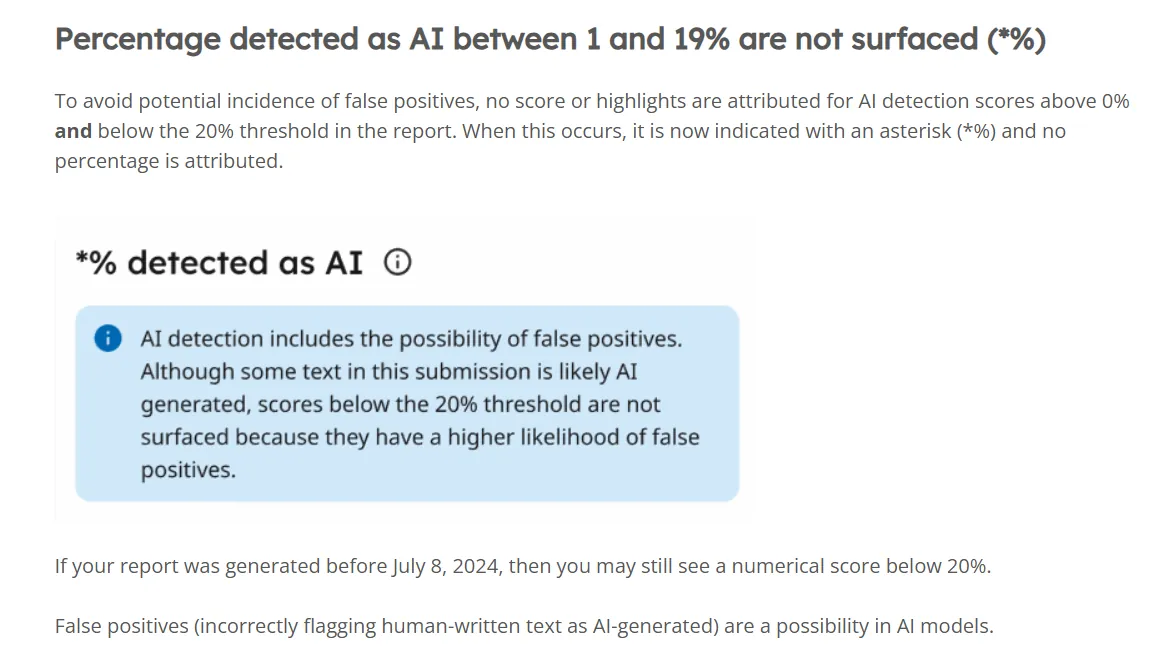
What the score display does tell you, according to Turnitin’s guide[3]:
| What you see | What Turnitin says |
|---|---|
*% (1% to 19% AI) |
Not surfaced. No percentage or highlights, because scores under 20% are less reliable. Reports made before July 8, 2024 may still show a number. |
| 20% to 100% | A percentage and highlighted sentences. Treat highlights as “areas of interest,” not proof. |
| No score | The submission has fewer than 300 words of prose, an unsupported file, or AI detection was off at the time. |
So an 18% score isn’t visible to your instructor as a number at all, and 25% is a signal to look closer, not a finding. Turnitin also warns that results can change after model updates. The University of Bristol notes that a draft and a final submission can get different AI scores[12] because the model was updated in October 2025, and Turnitin’s FAQ (updated October 14, 2026) says it updated the English model architecture again in October 2026 to improve accuracy where text moves between human and AI writing[1].
If your assignment is submitted through Canvas, see where the AI score appears and who sees it.
Which Universities Turned Off Turnitin’s AI Detector, and Why?
Several universities switched Turnitin’s AI detector off because they didn’t trust the numbers. Two have published clear explanations.
- Vanderbilt (August 2023)[5]. It cited the 750-paper calculation, the lack of transparency about how the tool works, and bias concerns. It concluded that AI detection is very hard, possibly impossible, and that detection software isn’t an effective tool.
- University of Waterloo (September 2025)[10]. It cited unreliability, bias against students whose first language isn’t English, and its own testing, then decided the cost outweighed the benefit.
- Jun 2023University of PittsburghTeaching Center turned it off, endorses no detector
- Jun 2023University of ArizonaDisabled for all courses, temporarily
- Aug 2023Vanderbilt1% of 75,000 papers is about 750 at risk
- 2023Johns HopkinsTurned off over false positives
- Apr 2025UC San Diego Extended StudiesAI detection off, plagiarism check stays
- Sep 2025University of WaterlooUnreliable, biased, not worth the cost
Others, including Johns Hopkins, Pittsburgh and Arizona, made similar moves. Our guide to what AI detectors colleges use lists them with links to each announcement.
This doesn’t mean your school has stopped using it. Policies differ by campus and by course, so your syllabus and your instructor remain the real answer.
What to Do If Turnitin Flags Your Paper
If Turnitin flags your paper, stay calm and gather your process. A flag starts a conversation. It doesn’t end one.
- Ask what was flagged. Which passages, and which policy applies? Turnitin tells instructors to read results alongside the school’s policy and the assignment rubric.
- Pull your drafts. Google Docs or Word version history, your outline, notes and source list show how the paper developed.
- Offer to explain it. Turnitin’s guidance suggests instructors ask students to explain the essay, their process and their key ideas. If you wrote it, you can.
- Don’t panic-edit the final. Rewriting the whole paper after a flag can muddy your own record. Show the drafts you already have.
- Ask about the review process. Most schools have a defined path for integrity questions, and many say a score alone isn’t enough.
Say you’ve written a lab report, and its methods section follows the same formula as thousands of others. It scores higher than the rest of your paper. Your lab notebook and version history answer the question in a single meeting.
How to Check Your Draft Before You Submit
You can’t run your school’s Turnitin check yourself, because students don’t see the AI indicator unless an instructor shares it. What you can do is see how your draft reads to AI detectors before you submit. For the checks teachers run beyond the score, such as version history and source checks, see how teachers detect AI.
No detector is 100% accurate, and different ones disagree. That’s why Draftout’s AI Detector scores your text with several detectors, including Originality.ai, GPTZero, Copyleaks and Scribbr, not just our own.
If several flag the same paragraph, reread it. Is it vague, overly smooth, or full of generic phrasing? Revise it in your own voice (here’s how to humanize AI text step by step), then check again.
Turnitin usually runs a similarity check on the same upload, so it’s worth testing your citations too. An AI plagiarism checker shows passages that match existing sources, so you can quote or cite them properly before your instructor sees the report.
Check before you submit. Paste your essay into Draftout’s AI Detector. The AI Detector check is free, and you’ll see an AI-likelihood score with the sentences that drive it.
If you want the full toolkit, Draftout’s plans start with a 2-day trial for $2, then $39.99/month.
Frequently Asked Questions
Can Turnitin AI detection be wrong?
Yes. Turnitin says its model may misidentify human-written, AI-generated and AI-paraphrased text, and that its score shouldn’t be the sole basis for action against a student. It reports a false positive rate under 1% for documents above 20% AI and about 4% for individual highlighted sentences.
Is 25% on Turnitin too high?
There’s no score that counts as too high. Turnitin says there is no “right” or “target” score, and it advises instructors to use highlights to start a conversation. What happens next depends on your school’s AI policy and your instructor.
Can Turnitin actually detect ChatGPT?
Often, but not reliably. In Temple University’s test, Turnitin rated 77% of ChatGPT-written texts as 100% AI, and its accuracy dropped for paraphrased and mixed texts. Treat a result as a likelihood, not proof.
Did Turnitin update its AI detector?
Yes. The University of Bristol reports an accuracy update to the AI writing report on October 14, 2025, and Turnitin’s FAQ says the English model architecture was updated in October 2026. Updates apply to new submissions, so a draft and a final can score differently.
Is Turnitin’s AI detector accurate for non-native English speakers?
Turnitin says it trained its model on second-language writers and found no bias against English-language learners. A Stanford-led study found seven other detectors flagged 61% of non-native writers’ essays as AI on average, though it didn’t test Turnitin. Independent testing of Turnitin on this question is limited, so treat the score with extra care.
Is Turnitin’s AI Detector Accurate Enough to Trust?
Turnitin’s AI detector is accurate enough to start a conversation, and not accurate enough to settle one. Its own numbers are cautious (under 1% false positives, about 4% at sentence level), the independent evidence is older and mixed, and several universities decided the risk wasn’t worth it.
Keep your drafts, know your school’s policy, and check your own writing before you submit. An AI checker that scores your draft with several detectors gives you a second opinion before the one that counts.
How We Checked This
- What we read. Every source below was opened and read on October 19 and 20, 2026. Turnitin’s guides and blog posts were read in a browser because they block automated tools. The Temple report and its addendum were read in full, not from summaries.
- How we used the numbers. Each figure in this article was checked against the page it comes from. Where a number appears only in press coverage, not on Turnitin’s own pages, we left it out (for example, the “98% accuracy” figure).
- What we did not do. We haven’t tested Turnitin ourselves; students can’t run it, and we have no institutional access. When we run our own test of AI detectors, we’ll add the method and results here.
- Changelog. October 20, 2026: first version; sources checked, Stanford figures and the Temple report date confirmed, Turnitin’s October 2026 model update added.
Sources
- [1]Turnitin, “Turnitin’s AI writing detection capabilities FAQs” (Turnitin Guides, updated Oct 14, 2026)False positive rate under 1% above 20% AI, the 50%/65% example, 700,000-paper validation, training on second-language writers, October 2026 model update. Vendor’s own figures · accessed Oct 20, 2026
- [2]Annie Chechitelli, “AI writing detection update from Turnitin’s Chief Product Officer” (Turnitin blog, May 2023)800,000-paper test, more false positives below 20% and at the start and end of documents, 54/26/10/10% distance of false-positive sentences. Vendor’s own figures · accessed Oct 19, 2026
- [3]Turnitin, “Using the AI Writing Report” (Turnitin Guides)Model “may not always be accurate”, not the sole basis for adverse action, *% display for 1–19%, 300-word minimum. Vendor documentation · accessed Oct 20, 2026
- [4]Annie Chechitelli, “Understanding the false positive rate for sentences of our AI writing detection capability” (Turnitin blog, Jun 14, 2023)Sentence-level false positive rate of about 4%, no “target” score, “initiate a conversation, not to draw a conclusion”. Vendor’s own figures · accessed Oct 19, 2026
- [5]Vanderbilt University, “Guidance on AI Detection and Why We’re Disabling Turnitin’s AI Detector” (Brightspace, Aug 16, 2023)75,000 papers in 2022, about 750 at a 1% rate, reasons for switching the detector off · accessed Oct 19, 2026
- [6]L. Salem, S. Fiore, S. Kelly, B. Brock, “Evaluating the Effectiveness of Turnitin’s AI Writing Indicator Model” (Temple University, 2023, PDF)120-text test: 93% human, 77% AI, 63% paraphrased, 43% hybrid; flagged sentences didn’t match the AI-written ones. An early version of Turnitin’s model · accessed Oct 19, 2026
- [7]Temple University, “Addendum to Evaluating the Effectiveness of Turnitin’s AI Writing Indicator Model” (2023, PDF)ZeroGPT, Copyleaks, Crossplag and Content at Scale on the same texts; none labeled every human text correctly · accessed Oct 19, 2026
- [8]BestColleges, “Testing Turnitin’s New AI Detector: How Accurate Is It?” (2023, updated Jul 8, 2025)Three-text test (human 0%, ChatGPT 100%). A demo, not a study · accessed Oct 19, 2026
- [9]University of Kansas, Center for Teaching Excellence, “Careful use of AI detectors”Margin of error of about 15 points, works best on long-form prose, Turnitin reports no bias against English-language learners · accessed Oct 19, 2026
- [10]University of Waterloo, “Discontinuing use of AI detection functionality in Turnitin” (September 2025)Internal testing inconclusive, human text flagged as 100% AI in more than one case, bias and cost · accessed Oct 19, 2026
- [11]W. Liang, M. Yuksekgonul, Y. Mao, E. Wu, J. Zou, “GPT detectors are biased against non-native English writers” (arXiv 2304.02819, 2023; published in Patterns)91 TOEFL essays, seven detectors, 61% average false positive rate, 18 essays flagged by all seven. Turnitin not tested · accessed Oct 20, 2026
- [12]University of Bristol, “Turnitin AI writing reports update” (Nov 20, 2025)October 14, 2025 update; a draft and a final can get different AI scores · accessed Oct 19, 2026

Table of contents
- How Accurate Is Turnitin’s AI Detector According to Turnitin?
- What Does a “1% False Positive Rate” Mean for You?
- What About the Sentence-Level Rate?
- What Do Independent Tests Say About Turnitin’s Accuracy?
- Can Turnitin Flag Human Writing as AI?
- Is 25% on Turnitin Too High?
- Which Universities Turned Off Turnitin’s AI Detector, and Why?
- What to Do If Turnitin Flags Your Paper
- How to Check Your Draft Before You Submit
- Frequently Asked Questions
- Is Turnitin’s AI Detector Accurate Enough to Trust?
- How We Checked This
- Sources
