
Most US colleges that check for AI use Turnitin. Its AI writing indicator sits inside the plagiarism checker they already pay for. Some schools use Copyleaks or GPTZero through Canvas or Blackboard instead, and a growing list has turned AI detection off entirely. Your syllabus and your course’s assignment settings tell you which of these applies to you.
The night before a deadline, “what AI detector do colleges use” stops being an abstract question. Say you’ve just finished a 2,000-word paper at 11 p.m., and you notice a small Turnitin logo on the Canvas upload page.
Is it checking for AI? Will your professor see a score? Most students have no idea, and that’s when the worry starts.
It’s a fair worry. Nobody explains how these tools reach your paper. This guide does. You’ll see which detectors colleges actually use, named schools that switched detection off (with links to their own announcements), what you can and can’t see, and how to find out what your college uses before you submit.
- Turnitin is the AI detector most colleges use. Its AI indicator was switched on inside existing plagiarism subscriptions in spring 2023; today it needs a separate Turnitin Originality license.
- Copyleaks and GPTZero are the main alternatives. Utah State, for example, moved from Turnitin to Copyleaks in 2023.
- Canvas and Blackboard have no AI detector of their own. Any AI score in them comes from a tool your school licensed.
- Vanderbilt, Johns Hopkins, Pitt, Waterloo and others have switched off Turnitin’s AI detection over false positives.
- Students can’t see the Turnitin AI score unless an instructor shares it. That’s why it helps to check your draft with several detectors before you submit.
What AI Detector Do Colleges Use Most Often?
The AI detector colleges use most often is Turnitin’s AI writing indicator. It sits inside the Turnitin plagiarism checker many campuses have licensed for years, which is why it spread so fast.
That history explains its reach. When Turnitin released AI detection in spring 2023, it switched the feature on inside existing subscriptions. James Madison University’s tech FAQ describes it plainly: the AI checker was added automatically to the existing subscription, at no cost and without warning. Vanderbilt noted the same rollout, with less than 24 hours’ notice and no option to disable it at first.
That has since changed. Turnitin’s own FAQ says AI writing detection is now available only to schools that license Turnitin Originality, and admins can switch it off.
So if your college uses Turnitin for plagiarism, the AI indicator may or may not be there. It depends on your school’s license and settings.
What Turnitin’s AI indicator actually reports
Turnitin’s AI score is an estimate of how much of the qualifying prose in your paper looks AI-generated. It isn’t a plagiarism score, and Turnitin says it isn’t a finding of misconduct. A few details shape what your instructor sees:
- Minimum length. The indicator only runs on long-form prose, with a minimum of about 300 words. Lists, tables and bibliographies usually aren’t counted. (Turnitin guide)
- Low scores are hidden. Scores from 1% to 19% show as an asterisk (
*%) with no highlighted sentences. Turnitin does this because low scores have a higher rate of false positives. - Instructors only. Turnitin says the indicator and report are not visible to students; an instructor can download the report and share it. Fresno State’s guidance says the same.
- It’s a starting point. The University of Kentucky reminds faculty that detector accuracy is low and false positives happen.
How accurate the Turnitin number is gets its own article: is Turnitin’s AI detector accurate? For now, remember this: a Turnitin AI score is one signal an instructor reads alongside your drafts, your past work and a conversation with you.
Other AI Detectors Colleges Use
Turnitin isn’t the only answer to “what AI checker do colleges use?” Some schools dropped it over cost or accuracy concerns and chose another vendor. In other cases, individual instructors paste text into a tool of their own choice.
Copyleaks
Copyleaks is a common campus-wide alternative. It plugs into Canvas the same way Turnitin does. In our comparison of ten AI detectors, Copyleaks rated our AI-written essay 100% AI and a human-written passage 0%.
- Utah State University replaced Turnitin with Copyleaks in July 2023. Its teaching site notes that AI detection is not included in the originality score shown in Canvas. The instructor opens the full report to see it.
GPTZero
GPTZero sells institutional plans with Canvas and Blackboard integrations. GPTZero also reports a beta that put its detector inside Blackboard’s SafeAssign for a few dozen US schools (vendor announcement). Colleges rarely announce campus-wide GPTZero licenses, so you’re more likely to meet it as a tool individual instructors use.
Originality.ai and others
Originality.ai, ZeroGPT, Sapling and Winston AI show up in research studies and in individual instructors’ workflows. Being tested in a study isn’t the same as being licensed by a college. Some competitor lists blur that line, so read “used by universities” claims carefully.
| Detector | How colleges use it | Where it appears | Can students see the AI score? |
|---|---|---|---|
| Turnitin | Campus license; AI detection needs the Turnitin Originality license | Canvas, Blackboard, Moodle and other LMSs, inside the Similarity Report | No, unless the instructor shares it |
| Copyleaks | Campus license at some schools (Utah State) | Canvas | Depends on settings; AI result kept separate from similarity score |
| GPTZero | Institutional plans; individual instructors | Canvas and Blackboard integrations, website | Only if the instructor shares it |
| Originality.ai, ZeroGPT, others | Mostly individual instructors and researchers | Vendor websites | Only if the instructor shares it |
- 1You uploadpolicy-paper.docx
- 2Canvas or BlackboardNo AI detector of its own. It passes the file on.
- 3Checker your college licensedTurnitin, Copyleaks or GPTZero
- 4Report for your instructor Similarity score AI indicator
Do Canvas and Blackboard Have Built-In AI Detection?
No. Canvas and Blackboard don’t have an AI detector of their own. An AI score only appears if your college connected a third-party tool such as Turnitin, Copyleaks or GPTZero.
Canvas. An Instructure Community moderator confirmed that Canvas does not provide an AI-generated paper detection feature. Plagiarism and AI checks come from integrations your school chooses to turn on.
Blackboard. SafeAssign, Blackboard’s built-in checker, is built for matching text against existing sources. AI scores in Blackboard come from integrations, such as Turnitin’s AI writing report, Copyleaks or GPTZero.
The logo on your upload page tells you more than the LMS name does. A Turnitin or Copyleaks badge means a licensed checker is attached. Whether its AI feature is on is a separate setting.
Which Colleges Have Turned Off AI Detection?
A growing number of colleges have switched AI detection off, mostly over false positives. Here are schools that announced it on their own sites:
| University | Decision | Source |
|---|---|---|
| Vanderbilt University | Disabled Turnitin’s AI detector, August 2023 | Vanderbilt Brightspace |
| University of Pittsburgh | Teaching Center disabled Turnitin AI detection and endorses no detector, June 2023 | University Times |
| University of Arizona | Turnitin AI detection temporarily disabled for all courses, June 2023 | Dean of Students |
| Johns Hopkins University | Turned off Turnitin AI detection over false positives, 2023 | JHU Teaching |
| James Madison University | AI checker no longer in its Turnitin subscription | JMU FAQ |
| UC San Diego Extended Studies | AI detection deactivated April 2025; plagiarism check stays | UCSD Extended Studies |
| University of Waterloo (Canada) | Discontinued Turnitin AI detection, September 2025 | Waterloo |
Why colleges switched it off
Vanderbilt’s math is the clearest explanation. Turnitin claimed a 1% false positive rate, and Vanderbilt submitted about 75,000 papers in 2022. At that rate, around 750 student papers could have been wrongly labeled as partly AI-written. Other schools cited bias against non-native English writers, cost and a lack of transparency about how the tool works.
Turning off Turnitin’s indicator doesn’t mean nobody checks. An instructor at one of these schools can still paste a paragraph into a public detector website. Policies often differ by course, so the syllabus still matters most.
Picture a student who writes in careful, formal English, a style detectors often misread. An instructor pastes one of their papers into a web detector, and it comes back “likely AI.”
An outline, notes and Google Docs history can settle that in one meeting. Whether or not your school runs a detector, saving your drafts is the habit that protects you.
Do College Admissions Offices Use AI Detectors?
Colleges don’t publicly say that their admissions offices run every application essay through an AI detector. Admissions policies usually ask you to confirm that the essay is your own work, and some publish rules on what AI help is allowed.
That doesn’t mean essays are never checked. Readers compare your essay with the rest of your application, and a voice that doesn’t match is noticeable without software. If you used AI to brainstorm or fix grammar, read each school’s own policy and follow it. Then make sure the final essay sounds like you.
How to Find Out What AI Detector Your College Uses
General lists of the AI detectors colleges use only go so far. You can usually find out what your own college uses in under ten minutes. Work through these steps in order:
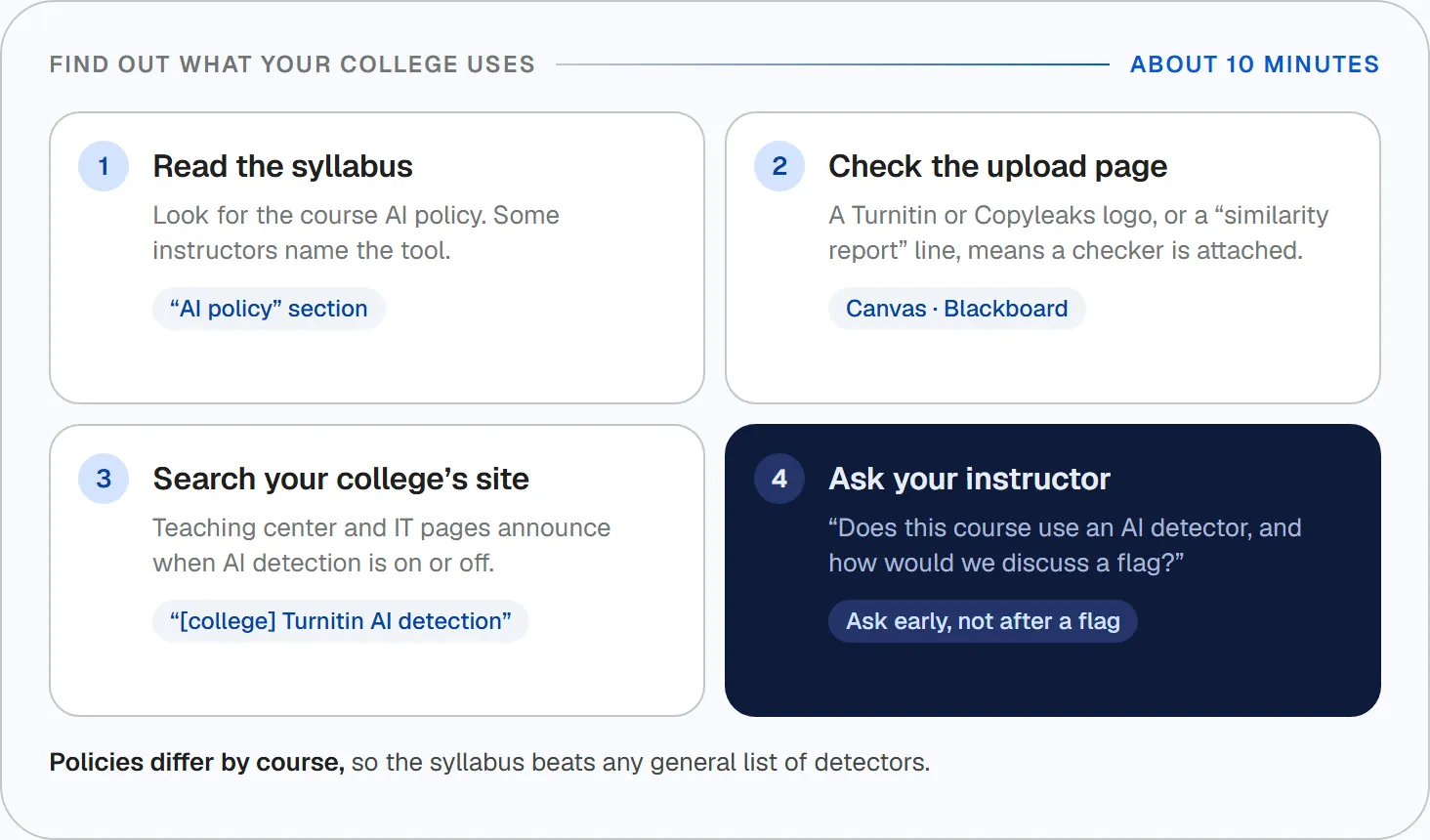
- Read the syllabus. Many instructors now include an AI policy, and some name the tool they use.
- Look at the assignment upload page. In Canvas or Blackboard, a Turnitin or Copyleaks logo, or a line about a “similarity report,” means a checker is attached.
- Search your college’s site. Try “[your college] Turnitin AI detection” or “[your college] AI detection policy.” Teaching centers and IT help pages often post announcements like the ones in the table above.
- Ask your instructor. It’s a normal question. Try: “Does this course use an AI detector, and if a passage is flagged, how will we discuss it?”
Ask early, not after a flag. Most instructors appreciate a student who wants to understand the rules up front.
Not sure what your school uses? You can still see how your draft reads to AI detectors. Check your draft with Draftout’s AI Detector and get an AI-likelihood score from several detectors before you submit.
What to Do Before You Submit
You can’t run your college’s own detector on your paper. You can still prepare, so a score never catches you off guard.
Keep a record of your process
Write in Google Docs or Word with version history on. Keep your outline, notes and source list. If anyone ever questions a passage, your drafts show how the paper took shape, and they’re stronger evidence than any score.
Check your draft with more than one detector
Detectors often disagree, and no single one is 100% accurate. That’s why Draftout scores your text with several detectors, including Originality.ai, GPTZero, Copyleaks and Scribbr, not just our own.
If several tools flag the same paragraph, reread it. Is it vague, overly smooth or full of generic phrasing? Revise it in your own voice, then check again.
To see why plain, formal writing sometimes scores as “AI,” read our guide on how AI detectors decide what looks AI-written.
If you’re flagged anyway
Stay calm. A high AI score isn’t a verdict, and most schools tell instructors not to treat it as one. Ask which passages were flagged, bring your drafts and offer to talk through your argument.
Lab reports are a common example. Their methods sections follow a fixed formula, so they can score high even when you wrote every word. Version history and your lab notes show that quickly.
Check before you submit. Paste your essay into Draftout’s AI Detector. The AI Detector check is free, and you’ll see an AI-likelihood score from several detectors with the sentences that drive it.
Frequently Asked Questions
Can Turnitin detect ChatGPT?
Turnitin’s AI indicator is designed to flag text likely written by large language models such as ChatGPT. It reports a likelihood, not proof, and it can miss edited AI text or flag human writing. Treat its score as a prompt for a conversation, not a final answer.
Do professors actually use AI detectors?
Some do, some don’t, and some schools have turned the feature off. Even where Turnitin’s indicator is on, many instructors only look at it when something else seems off, such as a voice that doesn’t match earlier work. For the other checks teachers run, from version history to source checks, see how teachers check for AI.
Can students see their Turnitin AI score?
No. Turnitin says the AI writing indicator and report are not visible to students. Your instructor can download the report as a PDF and share it with you.
What AI percentage is acceptable in college?
There’s no universal acceptable percentage. Turnitin itself hides scores below 20% because they’re less reliable. What counts is your course’s AI policy and the evidence of your own process, not a single number.
What AI detector do universities use? Is it the same everywhere?
No, there’s no single AI detector universities use. Turnitin is the most common, but each school chooses its own tools. Some use Copyleaks or GPTZero, and some have stopped using AI detection altogether.
Do colleges run essays through an AI detector automatically?
Only if the assignment is connected to a checker with AI detection switched on. In that case every upload is scanned, but the instructor decides whether to open the AI report.
Know What Your College Uses, Then Check Before You Submit
So, what AI detector do colleges use? Mostly Turnitin, sometimes Copyleaks or GPTZero, and at a growing number of schools, none at all.
Canvas and Blackboard don’t detect AI by themselves, and students usually can’t see the score. Schools that keep detection on still treat it as one data point, not proof.
Check your syllabus and upload page, keep your drafts, and when you’re ready, check your essay with Draftout’s AI Detector to see how it reads to several detectors at once. Revise anything that doesn’t sound like you, in your own voice, and submit with confidence.

Table of contents
