Comparison
Grammarly AI Detector Review: We Tested It on AI and Human Text
We ran the same texts through Grammarly’s AI detector and ours, plus two other detectors. Here is what each one scored, and what Grammarly’s own docs admit.
 Glib GoncharovCEO & Founder, Draftout
Grammarly AI Detector
- Our test, AI essay
- 44% AI
- Human text, 1813
- 0% AI
- Free option
- Web check, one percentage
- Paid
- Pro, listed at $12
- Trustpilot
- 3.1 / 5 · 10,491 reviews, all of Grammarly
Draftout AI Detector
- Our test, AI essay
- 99% AI
- Human text, 1813
- 0% AI
- Free option
- AI detector check
- Behind the score
- Several detectors, not just ours
Same 1,004-word AI essay and the same human chapter for both, free tiers, n=1 per tool. Grammarly: its own pages and Trustpilot. Draftout: our own product information.
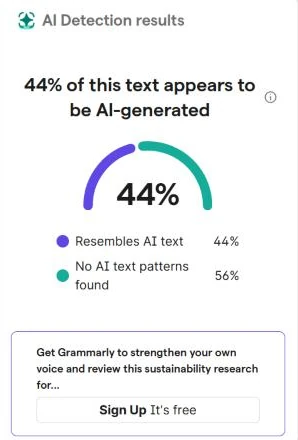
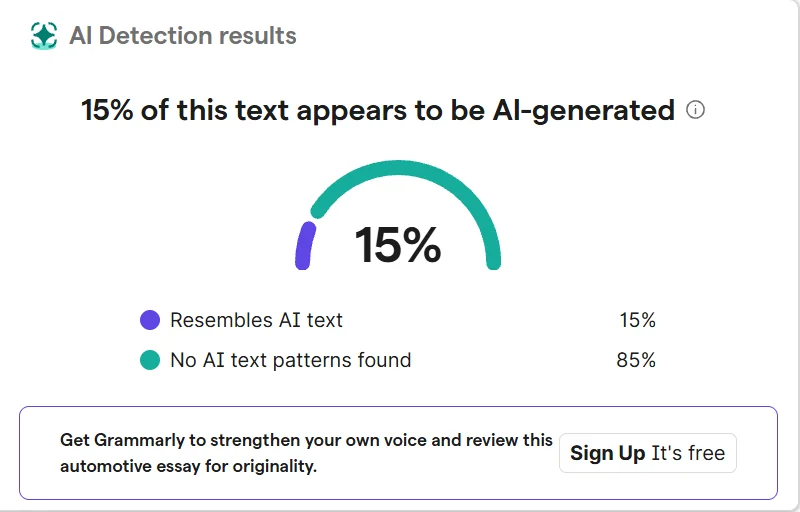
In our test, Grammarly’s AI detector rated an AI-written essay just 44% AI and a 293-word excerpt of it 15%, while three other detectors called both 99–100% AI. It scored a human text from 1813 correctly at 0%. So it raised no false flag, but it under-flagged AI text, especially short text. Grammarly itself says the score “should not be used as an objective source of truth”[2], and its “99% accuracy” comes from a research benchmark, not from essays like yours. Treat it as one opinion and check a draft with a second detector that Grammarly doesn’t own.
| Text | Grammarly AI Detector | Draftout, GPTZero, Pangram |
|---|---|---|
| AI essay, 1,004 words | 44% AI | 99–100% AI |
| AI excerpt, 293 words | 15% AI | 100% AI |
| Human text, 1813 | 0% AI | 0–1% AI |
Our test, November 2026, free tiers, n=1 per tool. Full results and method.
You’ve finished an essay, Grammarly is already open, and the AI score is one click away. The question is how much that number tells you about what your instructor’s tool will say.
This review covers how Grammarly’s AI detector works, what Grammarly’s own pages admit, what other reviews found and who wrote them, and our own test on one AI-written essay and one human text. It also answers the question many students actually type: does using Grammarly count as AI?
Disclosure: Draftout makes an AI detector, so we compete with Grammarly here. Most reviews that rank for this topic are written by companies that sell detectors too; we name them below. How we checked this.
- Our test: Grammarly rated an AI essay 44% AI and a 293-word excerpt of it 15%, while Draftout, GPTZero and Pangram said 99–100%. None of the four flagged a human text from 1813 (0–1% AI).
- Grammarly’s free web detector gives one percentage; Grammarly Pro adds the AI Detector agent with flagged sections. The plans page lists AI detection as unavailable on the Free plan inside the app.
- The “99% accuracy” and “#1 on RAID” claims come from Grammarly, about a research benchmark. Grammarly also says lightly edited AI text “may evade detection.”
- Grammarly’s own help says text rewritten by its Paraphraser or Humanizer agents is likely to be flagged, while ordinary grammar fixes typically don’t affect the score.
- GPTZero now belongs to Grammarly’s parent company, so “Grammarly plus GPTZero” isn’t two independent opinions.
Is Grammarly’s AI Detector Accurate?
Grammarly’s AI detector is accurate on the benchmark Grammarly cites, but there’s no public evidence that the same holds for a typical student essay, and Grammarly itself says no detector is 100% accurate[3]. The answer depends on which evidence you trust.
| Evidence | Who is behind it | What it says | Method stated? |
|---|---|---|---|
| Grammarly AI Detector page | Grammarly (vendor) | “99% detection accuracy” and #1 on RAID[1] | No sample size or error rate on the page |
| RAID benchmark | University researchers (ACL 2024) | More than 6 million texts from 11 models, 8 domains, 11 attacks[9] | Yes, public paper |
| Originality.ai review | Sells an AI detector | 99%, 93% and 71% AI on three ChatGPT texts; low recall on a RAID sample[7] | Partly; three texts, no human control |
| Quetext review | Sells an AI detector | 10% AI on one ChatGPT blog post[8] | One text, no human control |
| Our test | Draftout (sells an AI detector) | 44% AI on our AI essay, 15% on its first 293 words, 0% on a human text from 1813; GPTZero and Pangram rated both AI texts 100% | Yes, below |
Our selection of sources, accessed October 26, 2026. Vendor claims and competitor reviews are labeled as such.
Two lines on Grammarly’s own pages matter more than the headline number. The detector page says its model was trained on human writing and “AI-generated text created before 2021”[1]. ChatGPT launched in late 2022, so newer models aren’t in the part of the training data that page describes. The same page says “lightly edited AI-generated text may evade detection”[1]. Grammarly’s accuracy article adds that writers who speak English as an additional language are “particularly vulnerable” to being misclassified[3].
None of this makes the detector useless. It means a single score, from any detector, is a signal and not a verdict, which is what Grammarly says too.
How Does Grammarly’s AI Detector Work?
Grammarly’s AI detector estimates what percentage of your text resembles AI-generated writing. You paste text or upload a file on the free web page, click scan, and get a percentage with labels such as “Resembles AI text” or “No AI text patterns found”[1].
What you get depends on where you use it:
| Where | What it shows | Plan |
|---|---|---|
| Free web page (grammarly.com/ai-detector) | One overall percentage[1] | Free. In our test the first scan needed no account and the next one asked for a free sign-up; up to 1,400 words per scan |
| AI Detector agent in the Grammarly app, Google Docs or Word | Percentage, flagged sections marked in a side panel, citation help[2] | Pro; Business, Enterprise and Education if the admin turns it on[2] |
| Free plan inside the app | Not included: the plans page lists AI detection as unavailable[4] | Free |
As of November 6, 2026, from Grammarly’s own pages and our test of the free web page.
Grammarly’s help page lists the limits plainly. The tool “cannot provide a definitive conclusion,” shorter passages are harder to score, results may differ from other detectors such as Turnitin, and Grammarly offers no feature to reduce the score[2].
Want a second opinion on the same draft? Run it through our free AI detector check. It scores your text with several detectors, not just ours. It can’t predict what your school’s tool will say.
Our Test: Grammarly vs Draftout on AI and Human Text
We ran the same three texts through Grammarly’s AI detector, Draftout’s detector, GPTZero and Pangram, a detector that neither Grammarly nor we own. Here are the results.
Test texts.
- AI essay: an essay of 1,004 words with 19 APA references, generated with an AI model.
- AI fragment: the first 293 words of the same essay, because short texts often score differently from full ones.
- Human text: a chapter of Pride and Prejudice (1813), written long before AI writing tools existed.
| Text | Grammarly AI Detector | Draftout | GPTZero (owned by Grammarly’s parent) | Pangram |
|---|---|---|---|---|
| AI essay, 1,004 words | 44% AI | 99% AI | 100% AI | 100% AI |
| AI fragment, 293 words | 15% AI | 100% AI | 100% AI | 100% AI |
| Human text, 1813 | 0% AI | 0% AI | 1% AI | 0% AI |
Our test. Draftout: October 30, 2026, version 3.03, trial account. Grammarly, GPTZero (Model 5.0b) and Pangram (4.1): November 6, 2026, free accounts. Default settings, first attempt only. One AI text and one human text: n=1 per tool, not a benchmark. Draftout’s score combines several detectors, including third-party ones, so it isn’t a fully independent opinion.
Scorecard.
| Check | Pass if |
|---|---|
| Human text | The 1813 chapter isn’t labeled likely AI |
| AI essay | The full essay is labeled likely AI |
| Short fragment | We report how the score changes between the fragment and the full essay |

What we saw. Grammarly read most of our AI essay as human: 44% AI on the full 1,004 words and 15% on the first 293 words, where Draftout, GPTZero and Pangram all said 99–100%. The shorter text widened the gap, which fits Grammarly’s own note that shorter passages are harder to score. On the chapter from 1813 every detector got it right: Grammarly 0%, Draftout 0%, GPTZero 1%, Pangram 0%. So in this run Grammarly didn’t flag the human text, but it under-flagged the AI text. One AI text and one human text is n=1 per tool, so treat this as a reason to check with a second detector, not as a ranking.
Grammarly raised no false flag on the human text, but it read most of an AI essay as human.
Why the extra detector: GPTZero has belonged to the same company as Grammarly since June 2026[6]. It’s still a well-known reference, so we kept it, but it can’t serve as a neutral referee in a Grammarly review. The fourth column is Pangram, which has no ownership link to Grammarly or to us.

Does Grammarly Count as AI?
Using Grammarly’s grammar and spelling fixes typically doesn’t count as AI for its own detector, but text rewritten by Grammarly’s generative tools is likely to be flagged. That’s Grammarly’s own guidance: standard corrections (the red and blue underlines) “typically” don’t affect the score, while text rewritten by the Grammarly, Paraphraser or Humanizer agents is likely to be flagged[2]. What the humanizer does to citations and figures in an academic essay is covered in our Grammarly humanizer review.
Grammar fixes usually don’t count as AI for Grammarly’s detector. Generative rewrites usually do.
Whether it counts as AI for your class is a different question, and your syllabus answers it, not a detector. Some instructors allow grammar checkers and ban generative rewriting; some ban both. If you’re unsure, ask before you submit, and keep your drafts.
Other detectors, including the one your school uses, may read Grammarly-edited text differently from Grammarly’s own detector[2]. That’s one more reason to check with more than one tool.
What Is Grammarly Authorship?
Grammarly Authorship isn’t an AI detector: it records how your text got onto the page. It sorts each sentence by origin, such as typed by you, pasted from a website, a Grammarly suggestion or a non-web source, and you decide when to share the report[5].
Authorship is available in Grammarly Free and Grammarly Pro and works in Google Docs, Microsoft Word and the Grammarly editor[5]. For a student worried about a false flag, a record of the writing process can carry more weight than any detector score. The same idea works without Grammarly: Google Docs and Word both keep version history.
Grammarly Reviews: What Users Say
Grammarly has no separate rating for its AI detector. Its Trustpilot profile covers the whole company: 3.1 out of 5 from 10,491 reviews, almost all of them in English[10]. Most reviewers give 5 stars, but Trustpilot’s score gives more weight to recent reviews, so it sits well below that all-time share[12]. Grammarly has replied to 57% of its negative reviews, on average within four days, and Trustpilot lists no recent review invitations[10].
We searched the reviews for “AI detector”. Most of the 179 results are about Grammarly’s newer AI writing features and billing, not the detector. One from October 31, 2026 is about the detector itself: a UK reviewer says Grammarly scored a first draft written from their own notes as 98% AI, and that “it causes significant anxiety for no reason”[11]. That’s the opposite of what we saw, where Grammarly under-flagged AI text. One unverified review can’t be checked and our test is n=1 per tool, so read both as a reason to use a second detector, not as a verdict.
Grammarly vs Draftout
Grammarly is a writing assistant with an AI detector built in, and Draftout is an AI writing toolkit for students that checks a draft with several detectors. Pick by what you need.
| Grammarly AI Detector | Draftout AI Detector | |
|---|---|---|
| Free option | Free web check with one percentage[1]; in our test, one scan without an account, then a free sign-up | Free check |
| Flagged sentences | Pro: AI Detector agent[2] | Highlights sentences that read as AI-likely |
| Detectors behind the score | Grammarly’s own model[1] | Several detectors, not just ours |
| Where it works | Web, Grammarly app, Google Docs, Word[2] | Web |
| Writing-process record | Authorship, free and Pro[5] | No |
| Grammar checking | Yes, the core product | No |
| Price | Pro listed at $12 USD on the plans page[4] | AI Detector check is free; 2-day trial for $2, then $39.99/month for the full toolkit |
| Accuracy on our test | 44% on the AI essay (15% on a 293-word excerpt), 0% on the human text | 99% on the AI essay (100% on the excerpt), 0% on the human text |
Grammarly: its own pages, accessed November 6, 2026. Draftout: our own product information. Only the last row is a test result.
What Grammarly does well. It’s already where many students write, so the check takes one click. The first web scan needs no account, Authorship gives you a record of your process, and Grammarly is unusually candid about its detector’s limits. If you already use Grammarly and want a quick read on a draft, it’s a reasonable first check.
Pick Grammarly if…
- you already write in Grammarly, Google Docs or Word and want a score in one click
- you want grammar and spelling help in the same tool
- you want Authorship's sentence-by-sentence record of how your text got onto the page
- you want a quick scan without an account (our first scan needed none)
- your school's Grammarly plan has the AI Detector agent turned on
Pick Draftout if…
- you want a second opinion from a detector Grammarly doesn't own
- you want one score built from several detectors, not one company's model
- you want the sentences that read as AI-likely highlighted, so you can revise them in your own voice
- your draft is short: on a 293-word AI excerpt Grammarly said 15%, Draftout 100% (our test, n=1)
- you also want a humanizer and other student writing tools in the same place
Or use both. Check in Grammarly where you write, then get a second score from Draftout before you submit. If the two disagree, read the flagged sentences, not just the percentage.
Neither tool can see your school’s settings or predict your instructor’s result. That limit applies to every outside checker, ours included.
Grammarly AI Detector Alternatives
The best alternative to Grammarly’s AI detector is a detector that isn’t owned by the same company, used alongside it rather than instead of it. If two unrelated detectors agree that your draft reads as human, that’s more reassuring than one score. If they disagree, the honest takeaway is that detectors disagree.
Check with two detectors that don’t share an owner.
- GPTZero: a well-known standalone detector, now owned by Grammarly’s parent company[6]. Useful, but not an independent second opinion for a Grammarly result.
- ZeroGPT: a free detector from a different company, no account needed; in our ZeroGPT review it rated the same AI essay 30% AI and the human text from 1813 37% AI.
- Winston AI: a paid detector built for teachers, with a 14-day trial; in our Winston AI review it rated the same AI essay 96% human and the human text from 1813 100% human.
- Scribbr AI Detector: free with no account, with QuillBot’s model underneath; in our Scribbr AI detector review it rated the same AI essay 9% AI and the 1813 chapter 0%.
- All ten side by side: our best AI detector test ran 10 detectors, this one included, on the same AI essay and human text.
- Draftout: scores a draft with several detectors and highlights AI-likely sentences; the AI detector check is free.
- Your school’s own tool: if your instructor uses Turnitin, see whether students can use the Turnitin AI detector and what AI detectors colleges use.
A Pre-Submission Checklist (Works With Any Detector)
These steps protect you more than any single score does:
- Read your syllabus AI policy, including what it says about grammar tools.
- Know which Grammarly features you used. Grammar fixes and generative rewriting are different things, to Grammarly’s detector and to your instructor.
- Keep your drafts and version history, or turn on Authorship before you start writing.
- Check with two detectors that don’t share an owner, and read the flagged sentences, not just the percentage.
- Revise flagged passages in your own voice, then check again.
- If you’re flagged anyway, ask what the result is based on and bring your drafts. Our guide on how teachers detect AI shows what instructors look at besides a score.
Frequently Asked Questions
Is Grammarly’s AI detector accurate?
It depends on the text. Grammarly reports 99% accuracy on the RAID research benchmark, but says no detector is 100% accurate and that lightly edited AI text may evade detection. Reviews by other detector companies found mixed results on fresh ChatGPT text. In our test it rated our AI essay 44% AI and a 293-word excerpt 15%, while three other detectors said 99–100%; it scored a human text from 1813 correctly at 0%.
Is Grammarly’s AI detector free?
Partly. The web page at grammarly.com/ai-detector gives a free overall percentage for up to 1,400 words. In our test the first scan needed no account and the second asked for a free sign-up. The AI Detector agent with flagged sections is part of Grammarly Pro, and the plans page lists AI detection as unavailable on the Free plan inside the app.
Does Grammarly count as AI?
For Grammarly’s own detector, ordinary grammar and spelling fixes typically don’t affect the score, while text rewritten by its Paraphraser or Humanizer agents is likely to be flagged. Whether it counts as AI in your course depends on your syllabus, so ask your instructor if the policy isn’t clear.
Can Grammarly be detected as AI?
Text that Grammarly’s generative tools rewrote can be flagged, Grammarly says, and other detectors may score it differently from Grammarly’s own. Light corrections are less likely to matter. Keeping your drafts is the best protection either way.
What is Grammarly Authorship?
Authorship records how text got into your document, sentence by sentence: typed by you, pasted from a website, from a Grammarly suggestion or from a non-web source. It isn’t an AI detector. It works in Google Docs, Word and the Grammarly editor, and you choose when to share the report.
Is Grammarly’s AI detector the same as Turnitin?
No. They’re different models, and Grammarly says its results may differ from Turnitin’s. Students usually can’t run Turnitin themselves; our page on the Turnitin AI detector explains what you can check instead.
Grammarly vs QuillBot: which AI detector should I use?
Both are writing assistants with their own detector, and each detector reflects one company’s model. On the same AI essay, Grammarly said 44% AI and QuillBot 9%, while GPTZero and Pangram said 100%; our QuillBot AI detector review has the full results. Whichever you use, pair it with a detector from a different company before you rely on the score.
How is Draftout different from Grammarly’s AI detector?
Draftout scores your draft with several detectors instead of one and highlights the sentences that read as AI-likely, so you can revise them yourself. It doesn’t check grammar and can’t predict your school’s result. You stay the author either way.
Check Twice Before You Submit
Grammarly’s AI detector is a quick, free first read, and Grammarly is upfront that its score isn’t proof. Use it if it’s already in your workflow, keep your drafts, and get a second opinion from a detector Grammarly doesn’t own before you hit submit.
Draftout is an AI writing toolkit for students, with an ai detector and humanizer among its tools. The AI Detector check is free. The full toolkit is a 2-day trial for $2, then $39.99/month; see pricing.
How We Checked This
- What we read. Every source below was opened and read on October 26, 2026; Grammarly’s pages were checked again on November 6, 2026, and its Trustpilot profile was read on November 9, 2026. A review of Grammarly on fast.io isn’t cited, because its key numbers come from other publications we couldn’t check. GPTZero’s own Grammarly review returned an error page.
- What we tested. Draftout’s detector on October 30, 2026 (version 3.03, trial account). Grammarly’s free web detector, GPTZero (Model 5.0b) and Pangram (4.1) on November 6, 2026, with free accounts. Same three texts for every tool, default settings, first attempt only. We keep a screenshot of every result. The AI essay is our own unpublished text, so we don’t publish the texts themselves.
- What we did not do. We didn’t test Grammarly Pro’s AI Detector agent, Authorship or Grammarly’s humanizer; the humanizer gets its own review. We didn’t test Turnitin. One AI text and one human text is n=1 per tool, not a benchmark.
- Changelog. October 26, 2026: first version. November 6, 2026: test results added; Grammarly’s free-scan limits checked. November 9, 2026: Trustpilot reviews section, at-a-glance card and “Pick Grammarly / Pick Draftout” block added; test results unchanged.
- Corrections. If Grammarly’s plans or limits have changed, tell us and we’ll update the page with the date.
Sources
- Grammarly, “Free AI Detector” (grammarly.com). 99% accuracy and RAID #1 claim, training texts “created before 2021”, lightly edited AI text “may evade detection”, result labels. Vendor’s own page · accessed Oct 26, 2026
- Grammarly Support, “AI Detector user guide”. Where the AI Detector agent works, plans, “not an objective source of truth”, grammar fixes vs rewriting agents, may differ from Turnitin. Vendor documentation · accessed Oct 26, 2026
- Grammarly, “How accurate are AI detectors?” (Grammarly blog, updated Mar 25, 2026). No detector is 100% accurate; editing lowers reliability; English-as-an-additional-language writers “particularly vulnerable”. Vendor’s own page · accessed Oct 26, 2026
- Grammarly, Plans. Free, Pro ($12 USD as listed), Enterprise; AI detection listed as unavailable on Free. Vendor’s own page · accessed Oct 26, 2026
- Grammarly, Authorship. Records typed, pasted and AI-assisted text; available in Free and Pro; Google Docs, Word, Grammarly editor; user decides when to share. Vendor’s own page · accessed Oct 26, 2026
- Pulse 2.0, “Superhuman to acquire GPTZero” (Jun 23, 2026). Superhuman, the company formerly known as Grammarly, agrees to buy GPTZero; GPTZero stays a standalone product. News report · accessed Oct 26, 2026
- Originality.ai, “Grammarly AI Content Detector Review” (Nov 12, 2025). Three ChatGPT texts and a RAID sample. Written by a company that sells an AI detector · accessed Oct 26, 2026
- Quetext, “Grammarly AI Detector Review: How Accurate Is It?” (Apr 24, 2025). One ChatGPT blog post, no human control text. Written by a company that sells an AI detector · accessed Oct 26, 2026
- Dugan et al., “RAID: A Shared Benchmark for Robust Evaluation of Machine-Generated Text Detectors” (ACL 2024). Over 6 million generations, 11 models, 8 domains, 11 adversarial attacks. Peer-reviewed research paper · accessed Oct 26, 2026
- Trustpilot, Grammarly (www.grammarly.com). 3.1 / 5 from 10,491 reviews (7,173 five-star, 1,757 four, 401 three, 217 two, 943 one), all Grammarly products; 57% of negative reviews answered, 3.9 days on average; no recent invitations. Review platform, profile claimed by Grammarly · accessed Nov 9, 2026
- Trustpilot review, “It suggested my assignment was 98% AI” (Oct 31, 2026). A UK reviewer says Grammarly’s detector scored a first draft written from notes as 98% AI. Single unverified user review · accessed Nov 9, 2026
- Trustpilot Help Center, “TrustScore and star rating explained”. TrustScore isn’t a simple average; newer reviews hold more weight than older ones. Review platform documentation · accessed Nov 9, 2026
Table of contents
- Is Grammarly’s AI Detector Accurate?
- How Does Grammarly’s AI Detector Work?
- Our Test: Grammarly vs Draftout on AI and Human Text
- Does Grammarly Count as AI?
- What Is Grammarly Authorship?
- Grammarly Reviews: What Users Say
- Grammarly vs Draftout
- Grammarly AI Detector Alternatives
- A Pre-Submission Checklist (Works With Any Detector)
- Frequently Asked Questions
- Is Grammarly’s AI detector accurate?
- Is Grammarly’s AI detector free?
- Does Grammarly count as AI?
- Can Grammarly be detected as AI?
- What is Grammarly Authorship?
- Is Grammarly’s AI detector the same as Turnitin?
- Grammarly vs QuillBot: which AI detector should I use?
- How is Draftout different from Grammarly’s AI detector?
- Check Twice Before You Submit
- How We Checked This
